A Molehill Is Not a Mountain
Our tendency to overreact is one of humanity’s worst enemies. A careless word, a delayed reply, a driver who cuts us off: within seconds, a small event becomes a crisis in our minds, and we act on that distorted picture.
I do not believe emotions are the problem. Compassion, love and hope are what give our lives direction. The problem is letting negative emotions inflate a situation beyond its true size, and then reacting before reason has had its say.
As a mathematics teacher for 23 years, I learned that a wrong sign at the first line of a problem ruins every line that follows. Overreaction works the same way. My thesis is simple: if humanity made a habit of pausing and thinking before acting, the mathematics shows how much conflict, waste and suffering could be prevented.
Why We Make Mountains
Science has given precise names to this very human habit. Three of them explain most of what goes wrong.
Negativity bias. In a widely cited 2001 paper titled “Bad Is Stronger Than Good,” psychologist Roy Baumeister and his colleagues showed that negative events weigh on us far more than positive events of the same size. One insult can outweigh many compliments. This bias once kept our ancestors alive; today it often misleads us.
Catastrophizing. This is the habit of jumping straight to the worst possible outcome. A late text message becomes a broken friendship; a poor test mark becomes a ruined future. Cognitive behavioural therapy teaches people to recognize this thinking error and correct it.
The “amygdala hijack.” Daniel Goleman popularized this term for the moment the brain’s alarm centre reacts before its reasoning centre can weigh in. That is why a pause of even a few seconds can change a decision, and sometimes a life.
The good news is that all three can be trained. We cannot stop a negative feeling from arriving, but we can choose not to let it hold the pen.
The Mathematics of Escalation
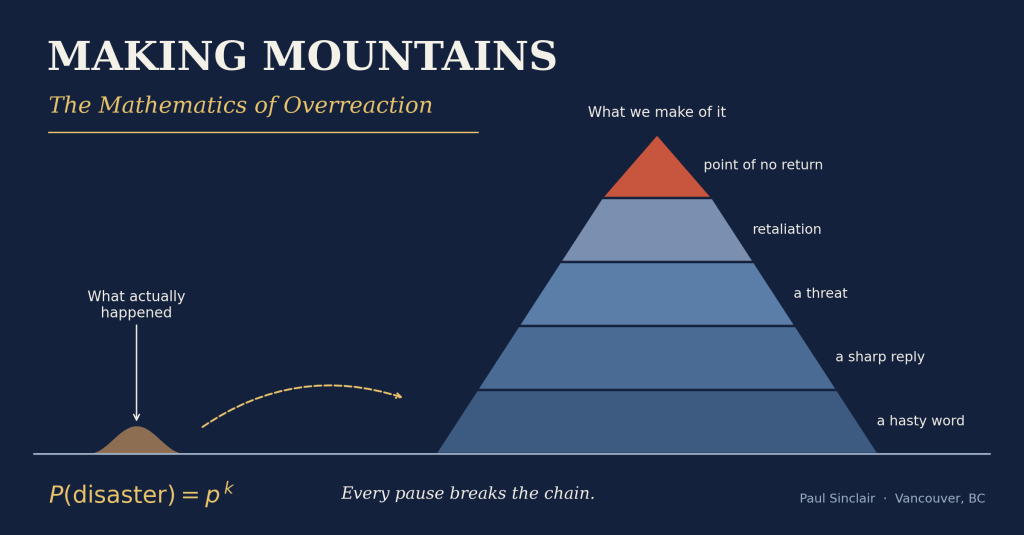
Every calmer step shrinks the risk of disaster exponentially, not just a little. A war, a divorce or a road-rage tragedy rarely begins with a single decision. It is a chain of escalations: an insult, a threat, a retaliation, a point of no return.
Suppose a conflict needs k escalating steps to become a disaster, and at each step there is a probability p that someone overreacts. If the steps are independent, the probability that the chain runs all the way to the end is:
P(disaster) = pk
Take a five-step chain (k = 5) and watch what happens as people learn to pause:
| Chance of overreacting at each step (p) | Chance of disaster (p5) | Compared with p = 0.5 |
| 0.5 | 3.13% | baseline |
| 0.4 | 1.02% | about 3 times lower |
| 0.3 | 0.24% | about 13 times lower |
| 0.2 | 0.03% | about 98 times lower |
Reducing each person’s tendency to overreact from 50% to 30% does not cut the danger by 40%. It cuts it by a factor of 13. This is the power of exponents, the same mathematics that makes compound interest so remarkable.
This is an illustrative model, not a measurement of any real conflict. Real steps are rarely independent, since one angry act makes the next more likely. But that only strengthens the lesson: the earliest pause is the most valuable one, because it breaks the chain before it gathers momentum.
The Price of Fear
When nations overreact to one another, fear becomes a budget line. According to the Stockholm International Peace Research Institute, world military spending reached $2,887 billion in 2025, the highest level SIPRI has ever recorded, equal to 2.5% of global GDP.
In the same year, about 645 million people, or 7.8% of the world’s population, faced hunger.
Now compare the two. The Ceres2030 research project estimated in 2020 that ending hunger by 2030 would require roughly an additional $33 billion per year (an approximate figure from that study). As a ratio:
33 ÷ 2,887 ≈ 0.011 = 1.1%
In other words, about one dollar out of every ninety spent on weapons could, in principle, help end world hunger. I do not claim that defence is unnecessary in a dangerous world. I claim that a world which reacted less and reasoned more would need far less of it.
There is hope in the data, too. Hunger has fallen for three consecutive years, with 43 million fewer hungry people than at the 2022 peak. Calm, patient policy works.
Reason Against Catastrophe
We cannot stop nature, but reason decides how many people nature takes. Floods, wildfires and heat waves are being intensified by a warming climate. Earthquakes are not caused by climate change, yet they teach the clearest lesson of all.
In January 2010, a magnitude 7.0 earthquake struck Haiti and killed somewhere between 100,000 and more than 300,000 people (estimates vary widely). Six weeks later, a magnitude 8.8 earthquake struck Chile and killed about 500 (approximate figures).
On the magnitude scale, each whole step releases about 32 times more energy, so the energy ratio between the two quakes is:
101.5 × (8.8 − 7.0) = 102.7 ≈ 500
Chile’s earthquake was roughly 500 times more powerful, yet it claimed a tiny fraction of the lives. The difference was not luck. It was decades of strict building codes, preparation and planning: thinking before acting, applied to a whole nation.
The same principle applies to climate. The Global Commission on Adaptation reported in 2019 that investing about $1.8 trillion in adaptation between 2020 and 2030 could return about $7.1 trillion in benefits, nearly four to one. It also found that just 24 hours’ warning of a storm or heat wave can cut the resulting damage by about 30% (approximate figures from that report). Prevention is simply calm thinking, done in advance.
An Honest Limit
Calm reasoning is necessary, but it is not sufficient on its own. Wars and famine also have economic, political and historical roots that a pause cannot erase. Poverty, unequal access to resources and old grievances will not disappear because one person counts to ten.
Nor should we silence emotion altogether. Neuroscientist Antonio Damasio studied patients whose brain injuries cut them off from their feelings. Their logic remained intact, yet they struggled to make even simple decisions, because nothing felt more important than anything else.
So the goal is balance, not suppression. Emotion tells us what matters; reason tells us what to do about it. Problems begin when we reverse their roles.
Conclusion: The Pause as a Way of Life
We began with a molehill: a careless word, a late reply, a driver who cuts us off. We have seen how quickly the human mind can turn it into a mountain, and why. Negativity bias makes bad news weigh more than good. Catastrophizing leaps to the worst outcome. The amygdala sounds the alarm before reason can speak.
Mathematics then showed us why this matters so much. Disaster is rarely one decision; it is a chain, and its probability is p raised to the power k. Lower each person’s tendency to overreact from 50% to 30%, and a five-step catastrophe becomes about thirteen times less likely. The exponent that makes disasters grow is the same exponent that makes calm so powerful.
The data showed us what overreaction costs. The world spent $2,887 billion on its militaries in 2025, while about 645 million people went hungry, a problem that roughly 1.1% of that sum could help solve. And two earthquakes in 2010 showed us what reason saves: Chile’s quake was about 500 times more powerful than Haiti’s, yet preparation kept its death toll to a small fraction.
The pause is not a cure for every evil. Poverty, injustice and history will not vanish because one person counts to ten. But it is the one remedy within every person’s reach. It costs nothing, needs no government, and can begin today.
In my own classroom, I once asked students to leave their phones in a box at the door. Many protested at first. The results later convinced them. Their first reaction was not their final judgment, and that is exactly the point: the first reaction rarely is.
So before we react, let us ask three simple questions. How big is this, really? What happens if I respond now? What happens if I wait?
Mountains are not born; they are built, one overreaction at a time. They can be taken down the same way: one pause, one breath, one calm decision at a time. Multiplied across eight billion people, that is not a small change. That is a different world.
Sources
- Stockholm International Peace Research Institute (SIPRI), world military expenditure 2025, press release, April 27, 2026: https://www.sipri.org/media/press-release/2026/global-military-spending-surges-2025
- FAO, IFAD, UNICEF, WFP and WHO, The State of Food Security and Nutrition in the World 2026: https://www.foodsecurityportal.org/node/3932
- Baumeister, R. F., Bratslavsky, E., Finkenauer, C. and Vohs, K. D. (2001), “Bad Is Stronger Than Good,” Review of General Psychology, 5(4), 323–370
- Goleman, D. (1995), Emotional Intelligence, Bantam Books
- Damasio, A. (1994), Descartes’ Error: Emotion, Reason, and the Human Brain, Putnam
- Ceres2030 (2020), Sustainable Solutions to End Hunger, Cornell University, IFPRI and IISD
- Global Commission on Adaptation (2019), Adapt Now: A Global Call for Leadership on Climate Resilience


Leave a Reply