
The most honest climate policy is a rising carbon price whose revenue goes back to every citizen in equal shares, spent first on the cheapest tonnes, with a separate levy on luxury emissions that a price alone cannot touch. Each part of that sentence can be checked with arithmetic a senior student could do.
Private jets carrying Bill Gates, Elon Musk and heads of government are a fair target for anger. One hour in a large business jet emits about as much CO₂ as a family car does in a year and a half. But anger is not a policy, and a policy aimed only at the wealthy would leave more than 99% of emissions untouched.
The honest question is therefore not who is a hypocrite. It is which measure removes the most carbon for each dollar, while protecting the households least able to absorb higher prices. That is an optimization problem, and mathematics is the right tool for it.
The scale problem
Private jets emit about 0.04% of global fossil CO₂; passenger cars emit about 8%, some 200 times more. The figures below are approximate, drawn from published studies up to 2025.
| Source | CO₂ per year (approx.) | Share of global fossil CO₂ (~37 Gt) |
| Passenger cars worldwide | 3,000 Mt | ~8% |
| All commercial and private aviation | 900 Mt | ~2.5% |
| Private jets worldwide | 15.6 Mt | ~0.04% |
Per person, the picture reverses. A large business jet burns about 1,500 kg of fuel per hour:
1,500 kg of fuel × 3.16 kg of CO₂ per kg of fuel ≈ 4.7 tonnes of CO₂ per flight hour
A gasoline car driven 15,000 km a year at 8 L/100 km emits 1,200 L × 2.31 kg/L ≈ 2.8 t a year. One flight hour therefore equals about 1.7 years of driving, and 200 flight hours equal the yearly output of some 340 cars.
Both facts are true at once. The wealthy pollute obscenely per head, yet ordinary transport, heating and industry produce almost all the tonnes. Any honest policy must reach both.
Cheapest tonnes first
A fixed climate target is met at the lowest total cost when the last tonne cut costs the same in every sector. Economists call this the equimarginal principle; mathematically it is a Lagrange multiplier problem.
Let sector i cut aᵢ tonnes at cost Cᵢ(aᵢ), and let the target be A. We minimize total cost under the constraint:
Minimize C₁(a₁) + C₂(a₂) + … subject to a₁ + a₂ + … = A ⟹ C₁′(a₁) = C₂′(a₂) = … = λ
The multiplier λ is the carbon price: the cost of the last tonne, equal everywhere.
A worked example uses two sectors with quadratic costs Cᵢ = kᵢaᵢ²/2, so marginal cost is kᵢaᵢ. Sector 1 is cheap, like contrail avoidance (k₁ = 5 $/t per Mt). Sector 2 is costly, like sustainable aviation fuel (k₂ = 50). The target is A = 10 Mt.
| Strategy | Cut in sector 1 | Cut in sector 2 | Total cost |
| Equal split (“everyone does their share”) | 5 Mt | 5 Mt | $687.5 million |
| Optimal (k₁a₁ = k₂a₂) | 9.09 Mt | 0.91 Mt | $227 million |
The optimal plan costs one third as much, with a marginal price of λ ≈ $45/t. The same $687.5 million spent optimally would cut about 17 Mt instead of 10. This is why the order of measures matters more than their moral appeal: cheap fixes such as contrail avoidance, building efficiency and clean electricity come first.
Who pays, who gains: fee and dividend
If every dollar of carbon revenue returns to citizens in equal shares, about half the population comes out ahead. The reason is simple: emissions rise with consumption, but the dividend is the same for everyone.
Consider a model country of 100 people whose average footprint is 18 t per year, close to Canada’s. The carbon price is $100/t.
| Group | People | Footprint (t/yr) | Carbon cost | Dividend | Net result |
| Lower-consumption | 50 | 10 | $1,000 | $1,800 | +$800 |
| Middle | 40 | 20 | $2,000 | $1,800 | −$200 |
| High-consumption | 10 | 50 | $5,000 | $1,800 | −$3,200 |
Revenue is 50×1,000 + 40×2,000 + 10×5,000 = $180,000, or $1,800 per person. The sum of net results is zero: no money is lost, only redistributed from heavy to light emitters.
The price still does its work. Every person, rich or poor, saves $100 for each tonne they avoid, so the incentive is intact even for those who receive a net payment. This is what makes the scheme honest: it changes behaviour without making the poor pay for the habits of the rich.
What a carbon price cannot fix
A uniform carbon price takes about 2.5% of a typical family’s income but less than a millionth of a billionaire’s wealth. Equal per tonne is not equal in effect.
| Person | Emissions (t/yr) | Cost at $100/t | Means | Cost as a share |
| Typical family member | 20 | $2,000 | $80,000 income | 2.5% |
| Billionaire flying 200 hrs | 1,000 | $100,000 | $100 billion wealth | 0.0001% |
The ratio between those two shares is 25,000 to 1. A billionaire will not change a single flight because of a $100 carbon price, so the price fails at the top exactly where public anger is strongest.
The honest remedy is a separate levy on luxury emissions: private jets, and frequent flying beyond a few trips a year. Set at an illustrative $1,000/t, about $4,700 per hour for a large jet, it would raise roughly 15.6 Mt × $1,000 ≈ $15.6 billion a year worldwide before people adjust. That is enough to fund some two million EV rebates of $7,500 each, turning the hypocrisy of the few into affordable clean cars for the many.
War, oil and who profits
When war raises fuel prices, commuters pay a premium larger than a $100/t carbon price, and none of it comes back to them. The 2026 war with Iran shows the arithmetic. All figures in this section are in US dollars.
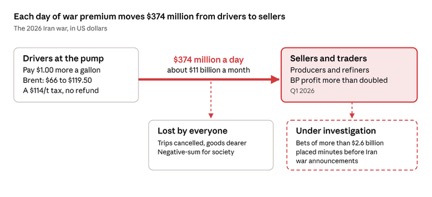
Where the war premium goes · 2026, US dollars
Every extra dollar paid at the pump becomes revenue for sellers, while the $2.6 billion figure is the size of the bets under investigation, not proven profit.
Before the US-Israel strikes began in late February, Brent crude stood near $66 a barrel. On March 9 it touched $119.50. By late April the US pump price averaged $4.18 a gallon, more than $1 above its pre-war level, while BP reported that its quarterly profit had more than doubled.
Convert that $1 per gallon into a carbon-price equivalent:
$1.00 per gallon ÷ 3.785 L per gallon = $0.264 per litre; $0.264 per litre ÷ 2.31 kg of CO₂ per litre ≈ $114 per tonne of CO₂
The war premium behaves like a $114/t carbon tax. A commuter burning 1,200 L a year pays about $317 extra. The difference is where the money goes: a carbon price returns its revenue as a dividend, while a war premium flows to producers, refiners and traders.
The zero-sum arithmetic
A $1 war premium moves about $374 million a day, or $11 billion a month, from American drivers to sellers. Americans burned 8.9 million barrels of gasoline a day in 2025, at 42 gallons per barrel:
8.9 million barrels a day × 42 gallons per barrel × $1.00 per gallon ≈ $374 million a day ≈ $11 billion a month
That money is not destroyed; it changes hands. If Q is the quantity drivers still buy and Δp the price rise, the transfer from buyers to sellers is Δp × Q: one side’s loss is exactly the other side’s gain, the definition of a zero-sum game.
The cruel part is the elasticity. The EIA notes that gas prices historically have little short-term effect on how much people buy, because they still have to get to work. When demand cannot fall, Q stays large, and so does Δp × Q. Captive consumers are the most profitable ones.
On top of the transfer sits a pure loss that no one collects, which economists write as ½ × Δp × ΔQ: trips cancelled, deliveries made dearer, budgets cut elsewhere. So the war premium is zero-sum between households and sellers, and negative-sum for society as a whole.
A carbon dividend uses the same formula in reverse. Its Δp × Q is collected publicly, counted publicly and paid back to every citizen. The arithmetic is identical; only the direction of the money, and the transparency, differ.
There is also a darker question. The US Department of Justice and the Commodity Futures Trading Commission are investigating oil futures bets totalling more than $2.6 billion, placed minutes or hours before announcements on March 23, April 7 and April 21 that sent prices down. Each bet wagered that oil would fall, as if someone knew peace news was coming.
Honesty requires precision here. The traders have not been publicly identified, and a source told NBC News in May that there was not yet evidence of criminal misconduct. The facts support a strong suspicion that war decisions leaked to traders; they do not show that any leader started a war to profit, and this essay does not claim it.
The remedy does not depend on proving motive:
- Ban elected officials, their staff and senior military officers from trading oil, gas and commodity futures, and require immediate disclosure of any related holdings.
- Tax windfall profits above a pre-war baseline and return the revenue as a dividend, exactly like the carbon price.
- Publish the outcome of trading investigations, so citizens can judge for themselves.
The big picture: France, Canada, the United States and the world
Eight months into the war, the oil shock is still not over, and each country has answered it differently. As of 5 October 2026, Brent crude traded near US$102.60 a barrel, about 57% higher than a year earlier, with traffic through the Strait of Hormuz still badly disrupted.
| Country | What happened at the pump | Main government response |
| France | Diesel rose from about €1.60 to as much as €2.36 a litre, and fuel use fell about 5% | Targeted fuel aid for workers who drive, plus a proposed “golden rule” that any extra VAT and excise from higher prices must fund relief, so the state never profits |
| Canada | Gasoline was the largest driver of inflation in July, up 25.7% in a year | The federal fuel excise tax was suspended from April to September, cutting 10 cents a litre at a cost of $2.4 billion, paid for by the oil windfall |
| United States | The national average passed US$4.18 a gallon in April | The largest share, 172 million barrels, of a record 400-million-barrel IEA emergency release; federal probes into suspicious oil trades |
| The world | The IEA called it the largest supply shock ever, hitting oil-importing emerging economies in South and Southeast Asia hardest | Coordinated stock releases by 32 IEA members, the sixth in the agency’s history |
The latest turn: Russian diesel for American drivers
On 9 October 2026, President Trump announced that Russia would supply diesel to the American and global markets: more than 300,000 tonnes immediately, 500,000 in November and 1,000,000 after that, with up to 4.8 million tonnes in all. The US Treasury issued a temporary licence to allow the shipments, with US diesel averaging $6.28 a gallon and the midterm elections a month away.
The arithmetic puts the deal in proportion. A tonne of diesel is roughly 7.45 barrels, and the United States uses about 3.8 million barrels of diesel and other distillates a day:
4.8 million tonnes × 7.45 barrels per tonne ≈ 36 million barrels ≈ 36 ÷ 3.8 ≈ 9.4 days of US diesel use
The first 300,000 tonnes cover about half a day of American consumption, and the volumes are shared with the global market. The deal can calm prices at the margin, but it does not replace the 15 to 20 million barrels a day that normally pass through Hormuz.
It also raises hard questions. The Associated Press reported that it came a month after a sanctions law aimed at Russia’s energy revenue, and that the White House had not said who pays for the fuel or when it arrives. Supporters see a pragmatic relief measure; critics see sanctions relaxed for a country at war with Ukraine. Either way, the logic of this essay applies: relief bought through the same market still flows partly to the sellers.
Three lessons follow, and each can be checked with the essay’s own arithmetic.
France confirms that captive consumers barely cut back. Diesel rose about 47%, yet use fell only 5%. That implies a short-run elasticity of about −0.05 ÷ 0.47 ≈ −0.11, which is exactly why the zero-sum transfer Δp × Q stays so large.
Canada shows how a flat tax cut favours heavy users. A 10-cent cut saves the rural driver burning 2,250 L a year $225, but the city driver burning 640 L only $64. Experts noted it also helps higher-income households more, because they buy more fuel. An equal dividend of the same total cost would have given every Canadian the same amount.
France’s golden rule is the dividend principle in another form. When a government refuses to profit from a price shock and hands the extra revenue back, it applies the same logic as fee and dividend. The difference is that it acts after the shock, instead of building the return into the price from the start.
Canada adds an honest complication: as an oil exporter, it gains from high prices at the national level even as its drivers lose. The war premium is therefore not only a transfer from households to companies, but also from importing countries to exporting ones, and the poorest importers pay the most.
Counting the socio-economic costs honestly
A $100/t carbon price raises gasoline by about 23 cents a litre and, on its own, cuts fuel use by only about 5% over several years. Honesty means admitting both the pain and the modest first effect.
2.31 kg of CO₂ per litre × $0.10 per kg ($100 per tonne) = $0.231 per litre
On a $1.80 litre that is a 12.8% rise. Studies put the long-run price elasticity of fuel demand near −0.3 to −0.6, so demand falls by roughly 0.4 × 12.8% ≈ 5%. The price works slowly because people cannot replace a car or a furnace overnight, which is why affordable alternatives must come alongside it.
The burden is also uneven by geography, not only by income:
- A rural driver covering 25,000 km at 9 L/100 km pays 2,250 L × $0.231 ≈ $520 a year, against about $150 for a city driver covering 8,000 km.
- Workers in oil, gas and coal regions face lost jobs, not just higher prices, and an equal dividend does not replace a salary.
- Prices rise once, as a step, and then stabilize; the shock is real but it is not permanent inflation.
An honest design therefore keeps back a small share of revenue, say 10%, for rural transit, retraining and regional transition funds. The remaining 90% still returns as dividends, so the lower-consumption half of households still comes out ahead.
The strongest objections
An honest essay must face the arguments against it, and several are serious.
- Voters may not believe the arithmetic. Canada paid quarterly rebates for years, yet the consumer carbon price was removed in April 2025 after a sustained affordability backlash. A dividend that people do not notice does not protect a policy politically.
- Prices alone move slowly. With elasticities near −0.4, deep cuts need regulation and public investment as well: clean electricity, transit, building codes.
- Innovation may matter more than price. Gates argues the decisive lever is lowering the Green Premium through technology, because India, Africa and Southeast Asia will adopt clean options only when they are cheaper, not because rich countries tax themselves.
- Carbon can leak abroad. Heavy industry may move to countries without a price unless a border carbon adjustment is added, which brings trade disputes.
- A luxury levy may be largely symbolic. At 0.04% of emissions it changes little physically, and the very wealthy can relocate or lobby. Its value is fairness and legitimacy, not tonnage.
- The science of some cheap fixes is uncertain. Contrail warming estimates carry a factor of two or three of uncertainty, so the cheapest tonne on paper may not be a tonne in the sky.
Conclusion
The honest alternative has five parts, and each one answers a number in this essay.
- Price carbon and return the money. Equal dividends make about half of households net gainers while keeping the incentive for everyone.
- Cut the cheapest tonnes first. The equimarginal rule meets the same target at one third of the cost of an “equal shares” approach.
- Levy luxury emissions separately. A uniform price is 25,000 times lighter for a billionaire than for a family, so private jets need their own charge, and its revenue can make EVs affordable.
- Protect the regions that lose. Setting aside about 10% of revenue for transit, retraining and transition funds addresses the losses a dividend cannot.
- Take the profit out of war prices. A war premium of about $1 a gallon is a $114/t tax paid to sellers, so windfall taxes and a trading ban for officials must return that money to the people who pay at the pump.
The hypocrisy of the wealthy is real, and it should be taxed. But the planet does not respond to moral outrage; it responds to tonnes. Mathematics tells us where the tonnes are, which ones are cheapest, and how to share the cost fairly.
Note: figures are approximate, taken from published studies up to 2025 (including Lee et al. 2021 on aviation forcing and Gössling et al. 2024 on private jets), and should be verified against current sources before publication.
Sources
The fee-and-dividend table, the billionaire comparison and the Lagrange example are illustrative models built for this essay, not data from a single study.
News and official data (2026)
- The Hill, via SEJ, 2 March 2026: Oil, gasoline prices jump amid Iran strikes
- AP, via FOX 11 Los Angeles, 9 March 2026: Oil prices spike as Iran war intensifies
- The Fiscal Times, 28 April 2026: Gas prices soar to four-year high on Iran war jitters
- Reuters, via Yahoo Finance, 15 April 2026: US probes suspicious oil trades made before Trump Iran pivots
- Bernama/dpa, citing ABC News and NBC News, 8 May 2026: US DOJ investigating possible inside trading during Iran war
- U.S. Energy Information Administration, 10 April 2026: Increasing fuel efficiency leads to decreasing gasoline consumption
- Enerdata, 11 March 2026: IEA member countries agree to release 400 mbl from oil stocks
- Reuters, via Sweetcrude Reports, 17 March 2026: IEA could release more oil stocks if needed
- The Logic, 14 April 2026: Ottawa cuts fuel excise tax until Labour Day as Iran war boosts prices
- Daily Hive, 17 August 2026: Gas is going to get more expensive for Canadians next month
- Assemblée nationale, written question no. 18282, 22 September 2026: Conséquences de la hausse des prix de l’énergie
- Gouvernement français, 23 September 2026: Carburants : ce que change la règle d’or
- MoneyMagpie, citing Trading Economics, October 2026: Oil price prediction October 2026
- Reuters, via Virginia Business, 9 October 2026: Trump says Russia to supply diesel to US and global market
- To Vima, 9 October 2026: Trump announces deal with Putin to free up to 4.8 mln tonnes of Russian diesel
- Associated Press, via ABC30, 9 October 2026: Trump says US to get diesel from Russia, relaxing pressure on Moscow
Research and reference works (to verify against the originals)
- Lee, D. S. et al. (2021). The contribution of global aviation to anthropogenic climate forcing for 2000 to 2018. Atmospheric Environment, 244.
- Teoh, R. et al. (2020). Mitigating the climate forcing of aircraft contrails by small-scale diversions and technology adoption. Environmental Science & Technology, 54(5).
- Google Research, American Airlines and Breakthrough Energy (2023). Contrail-avoidance flight trial results.
- Gössling, S. et al. (2024). Private aviation is making a growing contribution to climate change. Communications Earth & Environment, 5.
- Gates, B. (2021). How to Avoid a Climate Disaster. Knopf.
- International Energy Agency. Global EV Outlook (annual).
- IPCC (2022). Climate Change 2022: Mitigation of Climate Change. Working Group III, Sixth Assessment Report.
- Dahl, C. A. (2012). Measuring global gasoline and diesel price and income elasticities. Energy Policy, 41.
- Government of Canada. Canada Carbon Rebate and the end of the consumer fuel charge, April 2025.


Leave a Reply