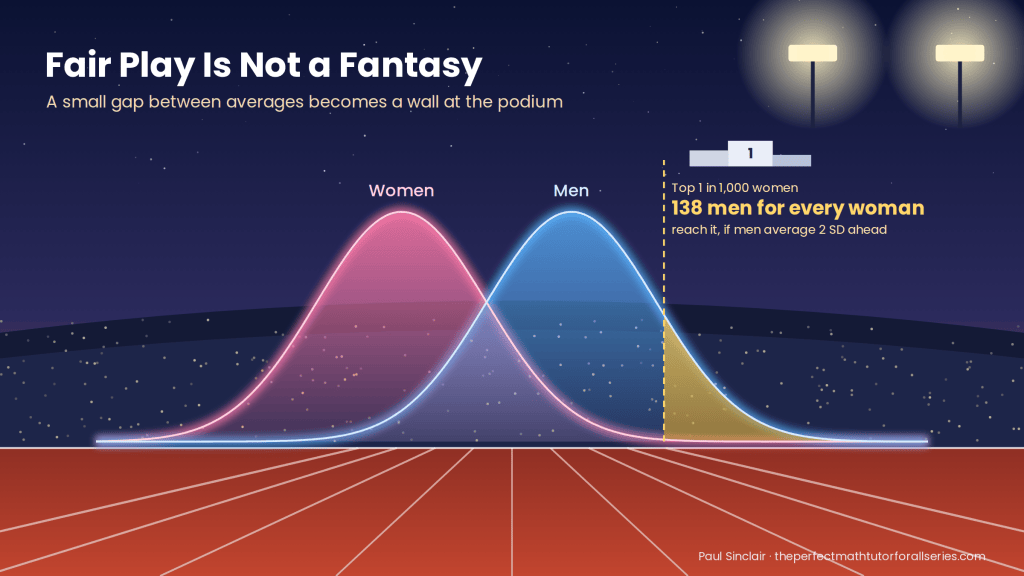
Why a “small” gap matters so much
The two curves overlap a great deal. Many women outperform many men, which is why the debate can seem ambiguous at first glance. But sport is not decided in the middle of the curves; it is decided at the far right, where medals, finals and scholarships are won. There, even a modest difference in averages becomes overwhelming. In this model, for every woman who reaches the top 1-in-1,000 level, 138 men reach it too.
That is the arithmetic behind the IOC’s decision to reserve the female category for biological females. Canada’s Secretary of State for Sport has publicly pledged to preserve “the integrity and fairness of sport categories,” yet he dismissed concerns about that very fairness as a conservative fantasy. Women athletes deserve a government whose words and actions measure up to the same standard.
Introduction

The case for a protected female category rests on measurement, not prejudice, and the measurements are clear. On March 26, 2026, the International Olympic Committee decided that, from the Los Angeles 2028 Games onward, only biological females may compete in the female category, verified by a one-time SRY gene screening (IOC policy).
Canada’s Secretary of State for Sport, Adam van Koeverden, answered on Facebook. He mocked the idea that drag queens are winning women’s volleyball games, calling it “a stupid conservative pseudo fantasy” (Quillette). Ridicule, however, is not an answer to the evidence the IOC relied on.
I taught mathematics and calculus for twenty-three years. I believe a public question deserves a public answer built on data. This essay argues three things: male development creates a large, measurable performance gap; hormone suppression narrows it only partly; and in elite competition, the mathematics of distributions turns a modest average gap into near-total exclusion of women from the podium. Ridicule is not a policy. Women athletes deserve better from the minister responsible for their sport.
1. The gap is real, and it is large
At the very top of sport, men outperform women by roughly 10% in running and by 17% to 19% in jumping. These are world records, the best performance ever recorded by each sex, so no one can blame poor training or small samples.
| Event | Men’s world record | Women’s world record | Men’s advantage |
|---|---|---|---|
| 100 m | 9.58 s | 10.49 s | 9.5% |
| 400 m | 43.03 s | 47.60 s | 10.6% |
| High jump | 2.45 m | 2.09 m | 17.2% |
| Long jump | 8.95 m | 7.52 m | 19.0% |
The peer-reviewed literature confirms the pattern. A review by Emma Hilton and Tommy Lundberg in Sports Medicine found that the male–female gap opens at puberty and reaches 10% to 50% depending on the sport (Hilton & Lundberg, 2021). It is widest where muscle mass and explosive upper-body strength decide the outcome.
The cause is not mysterious. During male puberty, testosterone builds larger hearts and lungs, longer bones, narrower hips, more muscle per kilogram and more haemoglobin per litre of blood. Those are the very engines of speed, power and endurance.
2. Lowering testosterone does not erase male puberty
Suppressing testosterone in adulthood removes only a small part of the advantage. Hilton and Lundberg found that after 12 months of treatment, lean mass, muscle area and strength typically fall by only about 5% (Hilton & Lundberg, 2021). A 5% loss does not close a gap of 10% to 50%.
The clearest real-world data come from the United States Air Force. Timothy Roberts and colleagues studied the fitness tests of 46 transgender women who began hormone therapy while serving (Roberts et al., 2021):
- Before treatment, they ran 1.5 miles 21% faster than the average female airman.
- After one year, the period then required by many sports bodies, they were still 9% faster.
- After two years, they remained 12% faster, even though their push-up and sit-up advantage had disappeared.
Hormones cannot shorten a femur, shrink a heart or reshape a pelvis. The skeleton built during male puberty stays.
3. The mathematics of the podium
A modest gap between averages becomes an overwhelming gap at the top, because podiums are decided in the far tail of a distribution. This is the heart of the matter, and it is pure mathematics.
Model the performance of women and of men as two normal distributions with the same spread σ, the male curve shifted ahead by d standard deviations. Take an elite woman at the top 1-in-1,000 level, which sits z = 3.09 standard deviations above the female mean. The share of men who beat her is:
P(a man beats the elite woman) = 1 − Φ(z − d)
Here is what each symbol means:
- z = 3.09 is the elite woman’s position: how many standard deviations she stands above the average woman. Only 1 woman in 1,000 is higher.
- d is the size of the male advantage: how many standard deviations the average man is ahead of the average woman.
- Φ (the Greek letter phi) is the standard normal distribution function. Φ(x) gives the share of a bell curve lying below x, so 1 − Φ(x) is the share lying above it.
For example, with d = 2: z − d = 1.09, and 1 − Φ(1.09) ≈ 13.8%. In other words, about one man in seven beats her.
Comparing that share with the 0.1% of women at her level gives the number of men who reach the same mark for every woman who does:
| Shift d (standard deviations) | Men beating a top 1-in-1,000 woman | Men per woman at that level | Men per woman at the 1-in-10,000 level |
|---|---|---|---|
| 1.0 | 1.8% | 18 | 33 |
| 1.5 | 5.6% | 56 | 132 |
| 2.0 | 13.8% | 138 | 428 |
| 2.5 | 27.8% | 278 | 1,114 |
| 3.0 | 46.4% | 464 | 2,361 |
Two lessons follow. First, the ratio grows as the level rises: the higher the stakes, the more completely women are displaced. Second, it takes very few male-bodied athletes to change outcomes, because medals, finals and scholarships are scarce. One entrant in a final of eight takes one woman’s place; three can take the whole podium.
The model is a simplification, and real sex differences vary by event. But its message matches the record books: at the elite level, a 10% gap is not a slight edge. It is a wall.
4. Safety, and why words matter
In contact and combat sports, the gap is not only about medals but about injury. In a University of Utah study of 20 men and 19 women with similar activity levels, men’s average punching power was 162% greater, and the weakest man out-punched the strongest woman (University of Utah, 2020). The IOC itself concluded that in some sports, mixing the sexes would not be safe (IOC policy).
The minister’s tone matters too. His own official statement promised a sport system that preserves the integrity and fairness of sport categories (CTV News). Yet his Facebook post treated the concerns behind those very words as a fantasy. The IOC’s own consultation found a strong consensus among female athletes in favour of sex-based eligibility. When a minister mocks a concern that most female athletes share, he tells those athletes their voices do not count.
5. Answering the other side honestly
A fair essay must face the strongest objections, and there are serious ones.
- Some studies find smaller differences. An IOC-funded study in the British Journal of Sports Medicine found that transgender women athletes had stronger handgrips than other women, yet lower jump height relative to body mass (Hamilton et al., 2024). A 2025 study of amateur volleyball players found no significant differences in grip, jump or aerobic capacity (British Journal of Sports Medicine, 2025). These studies are small, mostly non-elite and cross-sectional, so they cannot show what one person’s male puberty added. Still, they deserve a hearing, not dismissal.
- Canadian sport bodies have favoured inclusion. Canadian Women and Sport argued that bans are not backed by evidence and depart from national guidelines (CBC News). Their concern for transgender athletes is sincere.
- The numbers involved are small. Few transgender women compete at the elite level. But a rule is judged by what it permits, and a single place on a podium or team is a whole career for the woman who loses it.
As a libertarian conservative, I also reject cruelty toward anyone. Every person deserves dignity, safety and a place to play. The answer is not exclusion from sport but honest categories: a female category based on sex, and open or mixed categories where everyone can compete. Categories in sport describe bodies, not identities.
Conclusion
The evidence points one way: male development gives a large performance advantage, hormone suppression removes only a fraction of it, and at the elite level the mathematics of distributions turns that advantage into displacement. That is why the IOC, World Athletics and other federations have moved to sex-based eligibility.
None of this is a fantasy, conservative or otherwise. It is physiology, measured in seconds, metres and newtons, and it is arithmetic any secondary student can check. A minister who won Olympic gold in 2004, in a sport decided by fractions of a second, should understand better than anyone how much a small margin weighs.
The female category exists for one reason: without it, the best women in the world would rarely reach a final. Protecting it does not deny anyone’s humanity. It honours the girls and women who train for years and ask only for a fair start line. They deserve a minister who answers them with evidence, not with ridicule.
Sources
- IOC Policy on the Protection of the Female Category (March 26, 2026), via the Olympic Council of Asia.
- IOC review and female athletes’ consultation, Ministry of Sport.
- World Athletics SRY eligibility rule (July 30, 2025), Ghana News Agency.
- “The IOC Is Protecting Female Athletics”, Quillette, April 6, 2026.
- Secretary of State van Koeverden’s official statement, CTV News.
- Hilton & Lundberg, “Transgender Women in the Female Category of Sport”, Sports Medicine 51(2), 2021.
- Roberts, Smalley & Ahrendt, “Effect of gender affirming hormones on athletic performance”, British Journal of Sports Medicine 55, 2021.
- Morris, Link, Martin & Carrier, punching power study, Journal of Experimental Biology, 2020 (University of Utah summary).
- Hamilton et al., transgender athlete performance metrics, British Journal of Sports Medicine, 2024 (summary).
- Transgender and cisgender women volleyball players, British Journal of Sports Medicine 59(15), 2025.
- Canadian Women and Sport on Alberta’s policy, CBC News.
- World records: World Athletics official record lists (100 m, 400 m, high jump, long jump), as of October 2026.
The normal-distribution figures in section 3 are the author’s own calculations, using the standard normal function Φ.
Enjoyed this essay? Click the clapping hands below!
If you’re a WordPress.com member, you can also click ★ Like below.
New to commenting? See How to Leave a Comment.


Leave a Reply