1. A Vote, a Statement, and a Continent

On October 19, 2026, Albertans will finish voting in a referendum that asks, among other questions, whether their province should remain in Canada. In a calm and respectful statement, the Honourable Myles McDougall explained that he supports the reform questions seeking a fairer deal for Alberta, while choosing, on Question 10, to keep Alberta within Canada.
I agree with him, and I want to add something a mathematics teacher can offer: the numbers. Emotions run high in a referendum. Arithmetic does not.
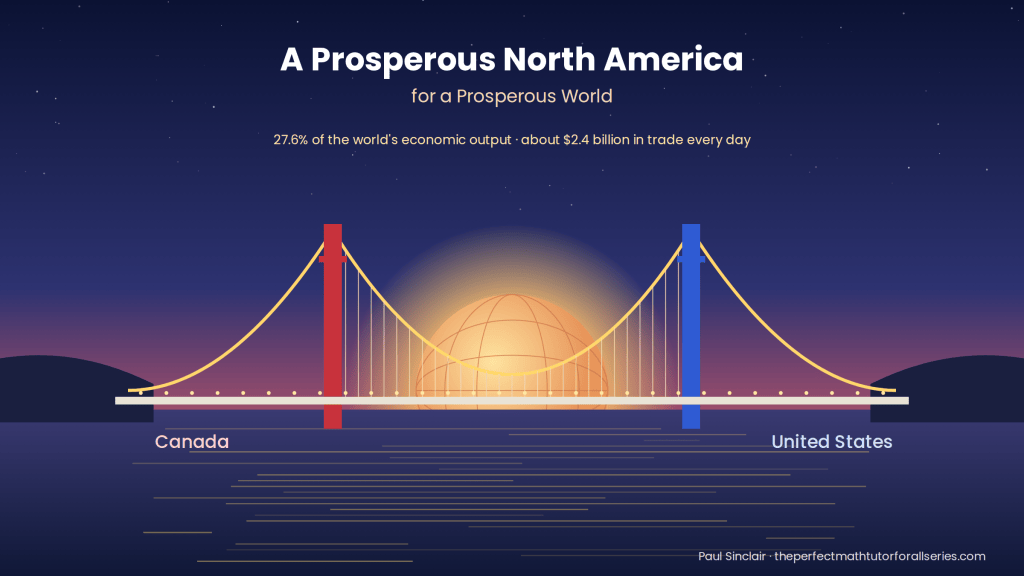
My thesis is simple. A strong Canada, with Alberta and Quebec at its heart, is a distinct, sovereign and bilingual nation that shares with the United States the world’s longest border, kept peaceful for over two centuries. Two sovereign nations, working hand in hand, make North America the most powerful continent, able to help maintain harmony and peace in the world. To stay strong, that continent needs shared protection of its borders and an immigration system that is fair, but strict: merit first, and numbers matched to each province’s capacity.
Politics will always be imperfect, and leaders will come and go. But the friendship between our two peoples can endure for generations to come.
2. Alberta Within Canada, in Numbers
Alberta is home to 5,101,050 people, out of 41,798,407 Canadians (Statistics Canada, July 1, 2026). That is 12.2% of the country. Yet Alberta produces about 15.4% of Canada’s GDP, and its real GDP per person is $81,121, against a national average of $65,423 (2012 dollars).
A first piece of classroom arithmetic: 15.4 ÷ 12.2 ≈ 1.26. Each Albertan produces, on average, about 26% more than the average Canadian.
Alberta is also an engine of growth. In 2025, Canada’s real GDP grew by 1.6%, and Alberta contributed 0.42 percentage points of it, almost as much as Ontario, a province with nearly three times its population. Statistics Canada projects Alberta will grow from about 5 million residents to over 7.3 million by 2050, the fastest of any province.
Albertans also give more to the federation than they receive. According to Statistics Canada, between 2007 and 2024 Albertans paid $293.5 billion more to Ottawa than they received back. A July 2026 Library of Parliament study confirms that, from 2015 to 2024, Alberta and British Columbia were the only net contributors, with Alberta the largest.
Why? University of Calgary economist Trevor Tombe explains that the gap comes mostly from good things: higher incomes and a younger population, which draws less on federal pensions. And in the hard pandemic year of 2020, the flow reversed: Alberta received more than it sent. In Professor Tombe’s view, that illustrates the value of Confederation. Canada works like an insurance policy. Alberta gives in good years, and the federation stands behind Alberta in hard ones.
Finally, energy ties Alberta to the whole continent. Alberta exported about 3.56 million barrels of crude per day in August 2025, mostly to the United States, and Canada supplies about 60% of America’s foreign crude oil.
3. North America Combined
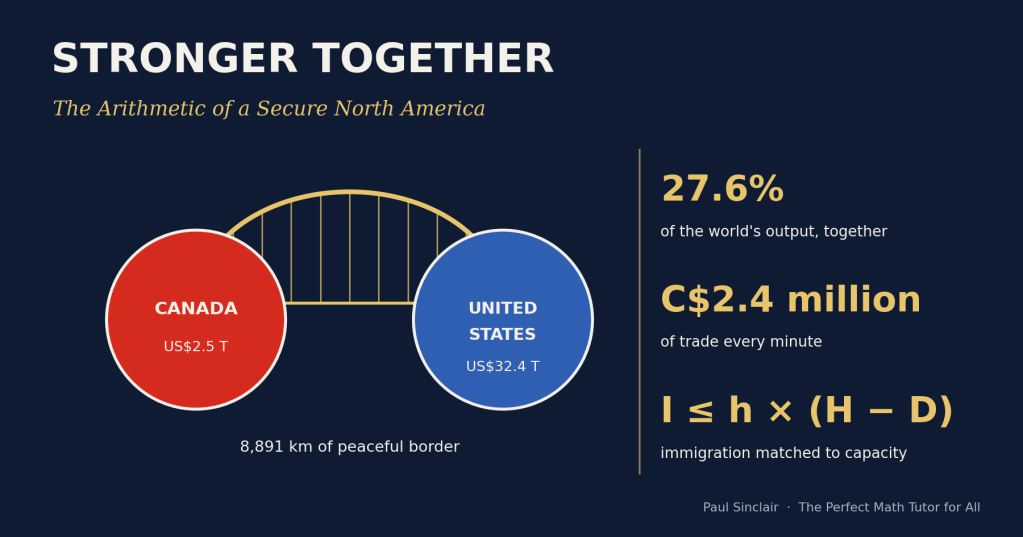
The IMF projects world GDP at $126.3 trillion in 2026, with the United States at $32.4 trillion and Canada at $2.5 trillion (US dollars). The arithmetic: (32.38 + 2.51) ÷ 126.30 ≈ 27.6%. Two neighbours produce more than a quarter of the world’s output, while home to less than 5% of humanity.
Trade binds them. In 2025, Canada exported $683.3 billion in goods and services to the United States and imported $604.1 billion (Canadian dollars). That is $1,287.4 billion in one year. Divide by 365 days: about $3.5 billion a day. Divide again by 1,440 minutes: about $2.4 million every minute, day and night. Canada is the largest export market for 36 American states, and among the top three for 46.
Canada also powers its neighbour. It provides about 85% of US electricity imports, 60% of US crude oil imports and 27% of the uranium for American nuclear power. Canadian uranium alone powers some 19 million American homes. Canada is the largest supplier to the US of potash, indium, aluminum and tellurium, and the second-largest of niobium, tungsten and magnesium: the minerals of batteries, aircraft, semiconductors and modern technology.
Water, Canada’s quiet strength
Canada holds about 7% of the world’s renewable fresh water, while Canadians are only about 0.5% of humanity. The arithmetic: 7 ÷ 0.5 = 14. Each Canadian is, on average, the guardian of about 14 times the world’s average share.
That water becomes electricity. Canada was the world’s third-largest generator of hydroelectricity in 2023, and in 2024 hydro produced 55.2% of Canada’s electricity, half of it in Quebec. That year, Canada supplied 81.9% of all US electricity imports: 35.8 million megawatt-hours. At roughly 10.5 MWh per American home per year (an approximate figure), that is enough for about 3.4 million American homes, even in a dry year.
But water is generous, not guaranteed. After another dry year in 2025, hydro’s share fell to 54.9%, and Canada’s imports of American electricity rose to a record 25.2 million MWh, much of it to British Columbia. When Canada’s rivers are full, Canada lights American homes. When the rain fails, American power plants help light Canadian homes. The shared grid is a living example of two sovereign nations helping each other.
Friendship needs care
Recent tensions have left a mark. Canada–US trade in the first quarter of 2026 was $1.9 billion lower than two years earlier, and trade in motor vehicles and parts fell by 18.9%. Cooperation is not automatic. Both sides must protect it.
4. A Fence Two Good Neighbours Mend Together
The Canada–United States border stretches 8,891 km: 5,061 km on land, marked by 5,528 boundary monuments, and 3,830 km on water. The arithmetic: 5,061 ÷ 5,528 ≈ one monument every 920 metres, all inspected and maintained jointly by the International Boundary Commission since 1908. Every six years, the Commission clears a strip along the line it calls a visible line between friendly neighbours.
Border protection must be taken seriously. But it must be measured honestly, too. In fiscal year 2025, US Customs and Border Protection seized 33.6 kg of fentanyl at the northern border, against about 3,992 kg at the southwestern border. The northern share was 0.8% of the total. The arithmetic: 3,992 ÷ 33.6 ≈ 119. For every kilogram seized coming from Canada, about 119 were seized at the southern border.
That is not a reason for complacency; it is a reason to keep it that way. Northern seizures in 2025 already exceeded those of the three previous years combined. Small, but rising.
Canada is doing its share. Its $1.3 billion Border Plan funds Black Hawk helicopters, drones, counter-drone technology, mobile surveillance towers and 1,000 new border officers, and Canada has appointed a Commissioner of the Fight Against Fentanyl, a former RCMP Deputy Commissioner.
As a border agency spokesperson put it, criminals try to exploit the border both ways. Drugs and illegal migrants can go south; illegal guns often come north. Neither country can secure the line alone, because the same line protects both homes.
And firmness belongs inside the law, not outside it. Due process belongs to everyone. Residence in Canada does not. A non-citizen convicted of a serious crime can be found inadmissible and removed, and the law already allows it.
The world’s longest border is not a wall between strangers, but a fence two good neighbours mend together.
5. Merit First, Numbers Matched to Capacity
Canada is already moving toward merit. The federal 2026–2028 plan holds permanent residents at 380,000 a year, with economic immigrants reaching about 63% of admissions in 2026 and 64% in 2027 and 2028, the highest share in over a decade. Temporary arrivals are cut sharply: 385,000 in 2026, down 43% from 673,650 in 2025. The arithmetic: 380,000 ÷ 41.8 million ≈ 0.9% of the population per year.
Provinces are being given a bigger voice. The Provincial Nominee Program rises from 55,000 places in 2025 to 91,500 in 2026, an increase of about 66%. Quebec has gone furthest: since the Canada–Québec Accord of 1991, it selects its own economic immigrants within Confederation.
Alberta already chooses by need. In 2026, its Advantage Immigration Program prioritizes health care, technology, construction, manufacturing, aviation, agriculture and rural communities, with 6,603 nominations for the year.
The capacity arithmetic: homes
CMHC estimates that Canada needs 430,000 to 480,000 new homes a year to restore 2019 affordability. In 2025, it started 259,028. The arithmetic: 259,028 ÷ 430,000 ≈ 60%. Canada builds about six homes for every ten it needs, a shortfall of at least 171,000 homes a year.
Capacity also differs by region. CMHC finds that Edmonton needs no extra supply beyond what is projected, while Vancouver, Montreal and Ottawa face large gaps. That is exactly why provinces should have a real say in the numbers.
A simple capacity model
A single year’s shortfall hides how gaps compound. Over a decade at the 2025 pace, Canada would fall short by (430,000 − 259,028) × 10 ≈ 1.7 million homes.
Now consider who those new homes must serve. With an average Canadian household of about 2.4 people (an approximate census figure), 380,000 permanent newcomers a year need about 380,000 ÷ 2.4 ≈ 158,000 homes. That is about 61% of all the homes Canada started in 2025, before any Canadian already living here forms a new household.
The conclusion does not hang on that one estimate. If the average household is anywhere between 2.3 and 2.5 people, newcomers would need between 59% and 64% of the homes started in 2025.
The condition for a sustainable intake can be written as one inequality. Let I be the newcomers admitted per year, h the average household size, H the homes built per year, and D the homes needed by people already here (young adults leaving home, families growing, separations):
I ÷ h ≤ H − D, which is the same as I ≤ h × (H − D)
No official figure exists for D, so the table below shows, for illustration only, how the maximum sustainable intake changes with it, with H = 259,028 and h = 2.4.
| Homes needed by existing residents (D) | Homes left for newcomers (H − D) | Maximum sustainable intake (I) |
| 100,000 | 159,028 | about 382,000 |
| 150,000 | 109,028 | about 262,000 |
| 200,000 | 59,028 | about 142,000 |
The lesson is not any single number. It is that intake must be set after counting the homes, not before. Strictness here is not a mood; it is a constraint.
There is one more lesson in that inequality, and it is the heart of good optimization. H is not fixed. Every carpenter, electrician and engineer a province selects helps raise H itself. Choosing builders first does not merely respect the constraint; it loosens it. The smartest choice is the one that enlarges what is possible.
The capacity arithmetic: doctors
The 2025 OurCare survey, with the Canadian Medical Association, found 5.9 million people in Canada without a regular family doctor, nurse practitioner or primary care team. Canada has 119 family doctors per 100,000 people. The arithmetic: to keep that ratio merely steady, 380,000 newcomers a year require 380,000 × 119 ÷ 100,000 ≈ 452 new family doctors every year, before helping a single one of the 5.9 million already waiting.
Compare that with how many family doctors Canada is training. In 2026, 1,746 graduates were matched to family medicine residencies (1,603 in the first round, 143 in the second). The arithmetic: 452 ÷ 1,746 ≈ 26%. About one new family doctor in four would be needed just to keep pace with each year’s newcomers, before replacing those who retire and before serving the 5.9 million already waiting.
This is why selecting doctors and nurses, as Alberta’s Dedicated Health Care Pathway does, is not a favour to newcomers. It is arithmetic in the service of everyone.
Compassion that ignores arithmetic is not compassion. A province cannot welcome more newcomers than it has homes, doctors and classrooms for, and it should choose first those who will build the homes and heal the sick.
6. What the Other Side Rightly Reminds Us
“Albertans have been taken for granted.” Many Albertans feel unheard in Ottawa, and the numbers show their frustration is not imagined: they have given more to the federation than they received for decades. That grievance deserves respect, not dismissal. But the same numbers point to a remedy within Canada, not outside it. In the hard year of 2020, the flow reversed and the federation stood behind Alberta. And geography does not change with a vote: Alberta’s oil still reaches the world through British Columbia and through the United States. A seat at the table is worth more than a closed door.
“A merit-based system forgets compassion.” Canada has humanitarian duties toward refugees, and families deserve to be reunited. A merit-based system does not abolish these; it sizes them honestly. Even in the 2026 plan, family reunification remains 84,000 places, or 22.1% of the target. Compassion and arithmetic are not enemies; compassion without arithmetic simply cannot keep its promises.
“Canada needs immigrants to offset an aging population.” Absolutely true, and this essay agrees. That is precisely why selection matters: a nurse, an electrician or an engineer strengthens the very services an aging population depends on. The question was never whether to welcome newcomers, but whom, how many, and where.
“After recent tensions, trusting the United States is naive.” Many Canadians feel hurt, and that feeling is understandable. But a relationship that has kept the world’s longest border peaceful for over two centuries is larger than any single disagreement. Administrations come and go; the International Boundary Commission has kept working, jointly and quietly, since 1908.
Conclusion: Stronger Together
I thank the Honourable Myles McDougall for a statement that is calm, respectful and courageous at a time when emotion runs high. I share his conviction that Alberta can press firmly for a fairer deal while remaining, on Question 10, proudly within Canada. I share his view that immigration is, under Section 95 of our Constitution, a responsibility the provinces must truly share, since it is the provinces that provide the homes, hospitals and classrooms newcomers rely on.
Where I part ways with Mr. McDougall is in degree, not in direction. As a minister, he understandably speaks for a flexible and welcoming approach. My own position is respectfully strict. As a French citizen, I have watched la douce France struggle for years with the consequences of immigration that outpaced its capacity to house, employ and integrate newcomers, a struggle still unresolved today. I do not wish that for our North American continent. Quebec has shown for over three decades that a province can choose its own economic immigrants within Confederation. Alberta deserves the same tool, and should use it fairly but strictly: due process for all, merit first, and numbers matched to capacity. Canada builds only six homes for every ten it needs, and each year’s newcomers require some 450 new family doctors just to stand still. Arithmetic is not cruelty; it is the only honest basis for a compassion that keeps its promises.
The numbers tell a larger story too. Canada and the United States together produce more than a quarter of the world’s wealth, trade $2.4 million every minute, and keep the world’s longest border peaceful with monuments, not walls. Canadian rivers light American homes, and in dry years American power plants light ours.
Politics will always be imperfect, and leaders will come and go. But two sovereign nations, working hand in hand, can keep North America strong enough to serve its own citizens and to help maintain harmony and peace in the world. That is not a dream. It is simple arithmetic: together, we are greater than the sum of our parts.
Paul Sinclair, retired mathematics teacher, Vancouver School Board
Sources
- Statistics Canada population estimates, July 1, 2026, via ATB Economics
- Provincial GDP shares and GDP per capita: RBC Economics, Provincial Forecast Tables, December 2025
- Statistics Canada, Real GDP by industry, provinces and territories, 2025
- Population projections to 2050: ATB Economics, January 2026
- Library of Parliament, Distribution of Federal Revenues and Expenditures by Province, July 2026
- Statistics Canada net fiscal contribution, 2007–2024, via Troy Media
- Professor Trevor Tombe, University of Calgary: CBC and CTV News
- Alberta crude exports: Oil Sands Magazine, October 2025; Canada’s share of US crude imports: Industrial Info Resources
- IMF World Economic Outlook, April 2026, via Wikipedia’s IMF table
- Global Affairs Canada trade figures, via The Canadian Press, August 5, 2026
- US Bureau of Economic Analysis data, via USAFacts; state export markets: CFIB fact sheet
- Energy and minerals: Embassy of Canada, Canada–US energy fact sheet; Natural Resources Canada, Joint Action Plan on Critical Minerals
- Fresh water: Environment and Climate Change Canada, Water FAQ
- Electricity: Canada Energy Regulator, Canada Energy Profile; Statistics Canada, Electricity year in review 2024, Electricity supply and disposition 2024 and Electricity year in review 2025
- Border: International Boundary Commission, About and Interesting facts
- Fentanyl seizures, CBP data: The Canadian Press fact check, August 2025
- Government of Canada, Strengthening Canada’s Border Security; Privy Council Office, Question Period Note, February 2026; Global News, RCMP border efforts
- IRCC, 2026–2028 Immigration Levels Plan, Permanent Resident Targets; temporary and family targets: Clark Hill
- Government of Alberta, AAIP processing information; 2026 allocation: immigration.ca, August 2026
- Housing: CMHC housing starts 2025, via Investment Executive; CMHC supply gaps by city
- Doctors: Canadian Medical Association, OurCare Survey 2025; CIHI ratio via The Globe and Mail
- Family medicine residencies: CaRMS, 2026 R-1 Match results and College of Family Physicians of Canada
Figures current as of October 15, 2026. Household size and US household electricity use are approximate.


Leave a Reply