Introduction: The same faces, every time
There is a small European coffee place near my home where I go every second week. The espresso is good, the pastries are better, and for a long time I paid little attention to the other customers. Then something began to strike me.
The same young people were always there. Tuesday morning, Saturday afternoon, a rainy Sunday: the same faces, the same corner tables, the same laptops. Each one was on task, typing, scrolling, frowning at a screen. Yet no one spoke to anyone. They sat a metre apart and seemed to live on different planets.
I wondered: do these young adults have jobs? Are they university students? After 23 years in a classroom, curiosity about young people is a habit I never lost. So one afternoon I did something unusual in a Vancouver coffee shop. I asked them.
What I learned is the subject of this essay, and my thesis is simple. Betting your future on a single unfinished app is not entrepreneurship; it is a trap. In the age of AI, more apps are launched than ever while new apps earn a shrinking share of the money, and a young person who skips a career to chase one loses years of income, experience and friendships that no app will repay. The four parts below show the trap from the inside, then put it to the test of recent data. The three conclusions offer a way out.
Part 1: Four freelancers, zero finished apps
Every one of them introduced themselves the same way: “I’m a freelancer.” Four of them had been building an “application” since they finished high school. I have changed their names, but not their stories.
Daniel, 24, has spent five years on a fitness app that “will beat everything on the market.” He has rebuilt it from scratch three times because each new version “wasn’t good enough to launch.” Nobody outside his family has ever used it.
Priya, 22, is building a budgeting app for students. She has a beautiful logo, a pitch deck, and a waiting list of eleven people, most of them cousins. She has not written a line of code in six months; she is “waiting for the right investor.”
Marco, 21, discovered that AI tools can generate an app in an afternoon. So he generates a new one almost every week: a recipe app, a dating app, a crypto tracker. None is finished. Each new idea feels more exciting than finishing the last one.
Sophie, 23, is designing a social network for dog owners. She is the most talented of the four and the most isolated. She told me, without irony, that she spends ten hours a day building a platform to help people connect, and that she has not seen a friend in months.
All four still live with their parents. None has applied for a job. Each one is waiting for the day the app sells and changes everything.
Part 2: The conversation
I did not lecture them. A teacher learns early that a lecture closes ears. Instead, I asked the questions I used to ask students before an exam.
“Daniel, how many people have paid for your app?” None. “How many have used it for a week?” He wasn’t sure. “Then how do you know it’s better than what’s already out there?” A long silence.
I asked Priya what she would do if no investor ever came. She laughed, then stopped laughing. I asked Marco which of his apps he would still be working on in a year. He could not choose one. I asked Sophie when she last had a conversation like the one we were having. She looked at the table.
Then I told them what I believed. Building your whole future on a single, unfinished app is not a career plan; it is a lottery ticket you have been holding for five years without checking the numbers. And freelancing can be a fine life, but only for people who have found a niche, a skill clients will pay for this month, not someday.
Two of them described themselves to me, quite seriously, as “CEOs.” I told them, gently, that a CEO with no employees, no customers and no revenue is not running a company. He is running out the clock on his own youth.
They were not stupid, and they were not lazy. They worked longer hours than many people with jobs. That is what troubled me most. They were trapped, and the trap looked exactly like hard work.
Part 3: The flood of AI-built apps
AI has multiplied the number of new apps about sevenfold since 2022, while the share of the money going to new apps has shrunk to almost nothing.
More apps than ever. The most recent large study, RevenueCat’s State of Subscription Apps 2026 (March 2026), draws on more than 115,000 apps and over $16 billion in revenue. In January 2022, about 2,000 new subscription apps launched each month; by January 2026, it was 14,700. The steepest rise began in early 2025, when AI tools let people build apps without knowing how to code. On Google Play alone, 42matters counted an average of 2,928 new apps a day as of October 19, 2026, and 54% of the apps there have never received a single rating.
14,700 ÷ 2,000 ≈ 7.4, about seven times more new apps each month than in 2022
Less money for newcomers. Apps launched before 2020 still earn 69% of all subscription revenue. Apps launched in 2025 or later, the AI “vibecoding era,” earn just 3%. Only 17% of new apps reached $1,000 a month in recurring revenue within two years, down from 19% the year before, and only 4.6% reached $10,000, down from 5.3%. One year after launch, the middle half of apps earn between $16 and $429 a month.
One caveat keeps the argument honest. RevenueCat is a company that sells tools to app makers, and its figures cover only apps already earning subscription revenue on its platform. A beginner’s unfinished app is not even in the sample, so the real odds for Daniel, Priya and Marco are worse than these.
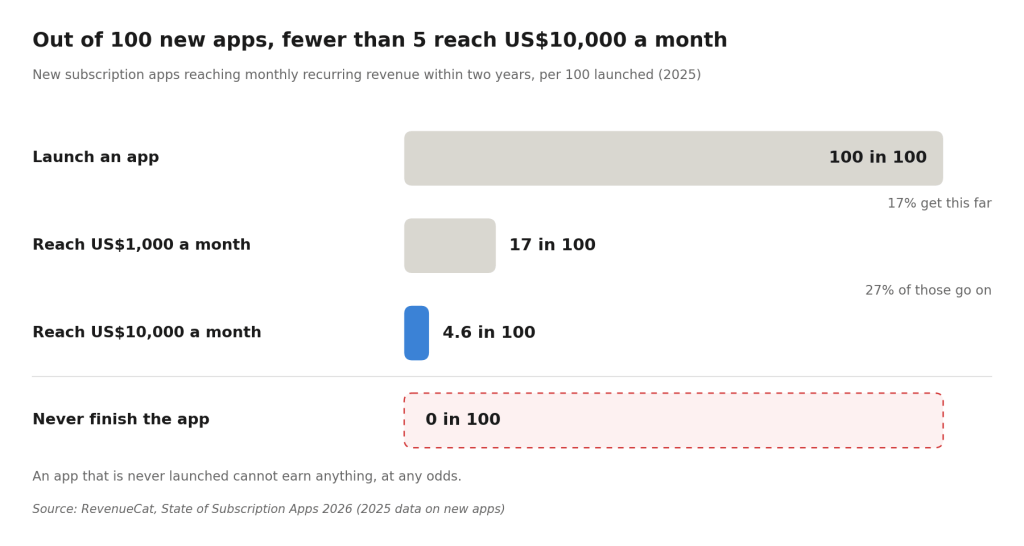
The funnel narrows twice, and the last rung is the trap: an app that is never finished sits below even the worst odds.
Part 4: The arithmetic of freelancing
A full-time minimum-wage job in BC pays about nine times what the typical Canadian freelancer earns, and an app that is never finished is worth exactly zero.
Young people are the most exposed. A Statistics Canada study published in June 2024 found that among self-employed youth aged 15 to 24, 41.7% were gig workers in their main job, compared with 26.2% of those aged 25 to 69. Young people who go it alone are the most likely to end up in short-term, unpredictable work.
What freelancers actually earn. The most recent Canadian income figure comes from Statistics Canada’s tax-record study: the median net income from gig work, which includes freelancing, was only $4,303. That figure dates from 2016, so it is older than I would like, but I could not find a newer national estimate. About half of the people who started gig work had no gig income at all the following year.
The comparison any student can do. A full-time job at BC’s minimum wage of $18.25 an hour (since June 1, 2026) pays $37,960 a year, about 8.8 times the median freelance income. Over five years, that is $189,800 against roughly $21,500. And a first job is only a start: the average hourly wage of Canadian employees reached $37.64 in September 2026, about double the minimum.
$18.25 × 40 hours × 52 weeks = $37,960 a year, and $37,960 ÷ $4,303 ≈ 8.8
The expected value of a dream. Any bet can be priced with one formula, where V is the payoff of success and C is what the attempt costs:
E = P(finish) × P(success, if finished) × V − C
For Daniel, after five years, P(finish) has been zero. Anything multiplied by zero is zero, so his expected value is simply minus C: five years of minimum-wage pay, $189,800, plus the experience, references and friendships he did not build. Even if he finished tomorrow, his app would have about a 17% chance of reaching US$1,000 a month within two years, and less than a 5% chance of reaching US$10,000.
The Elon Musk comparison makes it worse. Musk studied physics and economics, and his first company built a working product that was sold. The famous founders did not wait years for perfection. They shipped something, learned from real users, and kept going. My four freelancers had copied the dream and skipped the method.
Conclusion 1: What young freelancers can do
No one escapes a trap by being told they are in one. They escape by being shown a door. These are the doors I would hold open for Daniel, Priya, Marco and Sophie, and for thousands like them.
- Get a job, and keep the dream as a side project. A part-time or full-time job is not surrender. It pays the bills, teaches teamwork, builds a résumé, and turns the app into a project instead of a lifeline. Many successful products were built in evenings and weekends. And the jobs are there: British Columbia had 77,300 job vacancies in May 2026, a vacancy rate of 3.1%, above the national rate of 2.8%. Across Canada, the most openings are in restaurants and hotels, health care and construction, fields a young person can enter without years of training. Young people do compete for them, since youth unemployment in Canada was 13.0% in September 2026. That is a reason to start applying today, through co-op programs, apprenticeships and part-time work, not a reason to keep waiting at the coffee shop.
- Set a deadline and a kill rule. Give the app 90 days to reach real users. If, after that, fewer than a set number of strangers use it each week, stop, keep the lessons, and move on. Daniel’s five years would have been five useful experiments.
- Ship something small and unfinished. A simple version in the hands of 20 strangers teaches more than another year of polishing. Perfection is the most comfortable hiding place there is.
- Talk to customers before building. Priya should interview 30 students about money before writing more code or chasing investors. If they won’t give her 15 minutes, they won’t give her $5 a month.
- Pick one idea and finish it. For Marco, AI is a firehose of beginnings. The rare skill now is finishing. One completed app, however modest, is worth more than fifty abandoned ones. With 14,700 new subscription apps launching every month, only the ones that are finished, launched and improved with real users have any chance at all.
- Learn a skill AI cannot replace. Real expertise in a field (health, finance, education, a skilled trade) plus enough technology to use AI well is a far stronger position than “I can make apps.” College programs, co-op placements and apprenticeships exist for exactly this.
- If you want to freelance, freelance properly. That means a niche, a portfolio, paying clients, invoices and taxes. A freelancer with no clients is not self-employed; they are unemployed with a laptop.
- Leave the laptop and see people. For Sophie above all: join a meetup, a coworking space, a sports club, a volunteer group. Loneliness quietly drains judgement as well as happiness, and other people are where opportunities usually come from.
Conclusion 2: What parents, mentors and schools can do
Young people rarely climb out of this trap alone; the adults around them hold the ladder.
- Parents, love them enough to set terms. A home is a gift, but an open-ended one can become a cage. A modest rent, a timeline, and honest, regular conversations about the plan are acts of care, not cruelty.
- Find them a mentor. Someone older who has built things, failed, and rebuilt. Retired teachers, engineers and business owners are everywhere, and most would gladly give an hour over coffee.
- Schools, teach the arithmetic of careers. High schools and colleges can show students the real odds of the app stores and of freelancing, alongside co-op programs, apprenticeships and trades training. One lesson built on the numbers in this essay would be a good start.
- Treat AI as a tool, not a lottery ticket. Young people should learn to use AI to become better nurses, electricians, accountants or teachers, not to mass-produce apps that nobody downloads.
Conclusion 3: What we owe them
It would be easy to call these young people delusional and walk away. I don’t think that is fair. They grew up being told that anyone with a laptop and an idea could become a billionaire, and every screen they own repeats the story. The trap was built for them; they simply walked into it.
Every generation believes its parents are dinosaurs. These young people are right that the tools have changed. But the old lessons have not: finish what you start, earn before you spend, and keep real friends. It is worth remembering that the “dinosaurs” are the ones paying for the Wi-Fi. And dinosaurs, after all, lasted 165 million years, which is longer than most apps.
What they need is not mockery but honest arithmetic, a few adults willing to ask hard questions, and a door back into the world of work and people.
The arithmetic fits in one line. A minimum-wage job in BC pays about $38,000 a year, nearly nine times what the typical Canadian freelancer earns, and an app that is never finished is worth exactly zero. So the concrete plan is simple: take a paid job now, give the app a 90-day deadline and real users, learn one skill AI cannot replace, and spend at least one evening a week with people instead of a screen. The dream can stay; it just cannot be the whole plan.
Two weeks later, I went back to the coffee shop. Daniel told me he had applied for a job at a sporting goods store, “just to learn how people actually buy fitness stuff.” Sophie was sitting with someone, talking. It was a small start. But small starts, unlike perfect apps, actually happen.
Sources
Government of British Columbia, Minimum wage:
$18.25 per hour since June 1, 2026.
RevenueCat, State of Subscription Apps 2026 (March 2026): revenue milestones and earnings of new apps, 2025 data.
PPC Land, report on the full RevenueCat 2026 study (March 14, 2026): monthly launches of new subscription apps and revenue share by launch year.
42matters, Google Play Statistics and Trends: daily app releases and ratings, as of October 19, 2026.
Statistics Canada, Labour Force Survey, September 2026 (October 9, 2026): youth unemployment and average hourly wages.
Statistics Canada, Job vacancies and job vacancy rate, May 2026 (July 30, 2026): job vacancies in British Columbia and by sector.
Statistics Canada, Experiences of self-employed workers in Canada, 2023 (June 3, 2024): share of self-employed youth in gig work.
Statistics Canada, Measuring the Gig Economy in Canada Using Administrative Data (2019): median net gig income, 2016.


Leave a Reply