
Floods everywhere, and a question people whisper
Last weekend, storm DANA Adam dropped up to 700 litres of rain per square metre in 24 hours on parts of the Valencia region. At least four people died, and crews carried out more than 400 rescues. (Euronews)
This autumn alone, floods have also hit Catalonia, Castilla-La Mancha, Marseille and Corsica. Two years ago, the Valencia floods of October 2024 killed 228 people. (ARA)
Floods have always existed. But when disasters seem to multiply, a quieter question spreads on social media: are these floods being engineered, perhaps to justify climate policies at the expense of innocent people?
As a retired mathematics teacher, I decided to treat this suspicion the way I treated every claim in my classroom: test it against the numbers. My answer, stated up front, is no. But the numbers reveal something behind the scenes that is real, and far more troubling.
The suspicion, examined claim by claim
Within a day of the 2024 Valencia disaster, three stories went viral: a HAARP “weather attack”, foreign cloud seeding, and dams secretly demolished by the government. Spanish fact-checkers at Maldita.es traced each one. (Maldita)
- HAARP. This Alaska programme studies the ionosphere, far above the weather. It has no capacity to influence rain or storms. (Euronews)
- Cloud seeding. Spraying silver iodide is real, but Spain’s weather agency AEMET estimates it adds about 20% rainfall at best, to clouds that already exist. (Euronews)
- Demolished dams. There is no record of any dam, reservoir or weir demolished in the affected area between 2018 and 2024. (Maldita)
And the storm was no surprise: AEMET had warned of it several days before. (Maldita) A secret weapon announced days in advance by public forecasters would be a strange secret.
There is also a simple test of motive. Spain’s public insurer, the Consorcio de Compensación de Seguros, expects to pay about 4.8 billion euros for that single flood. (Consorcio) Insurers are raising premiums because they are losing money. Nobody burns billions of their own money to win an argument.
What really changed: warmer air, heavier rain
The real culprit is a law of physics every chemistry student meets: warmer air holds more water vapour, about 7% more for each degree Celsius. When autumn cold air meets a warm Mediterranean, the sky has more water to release. (WMO)
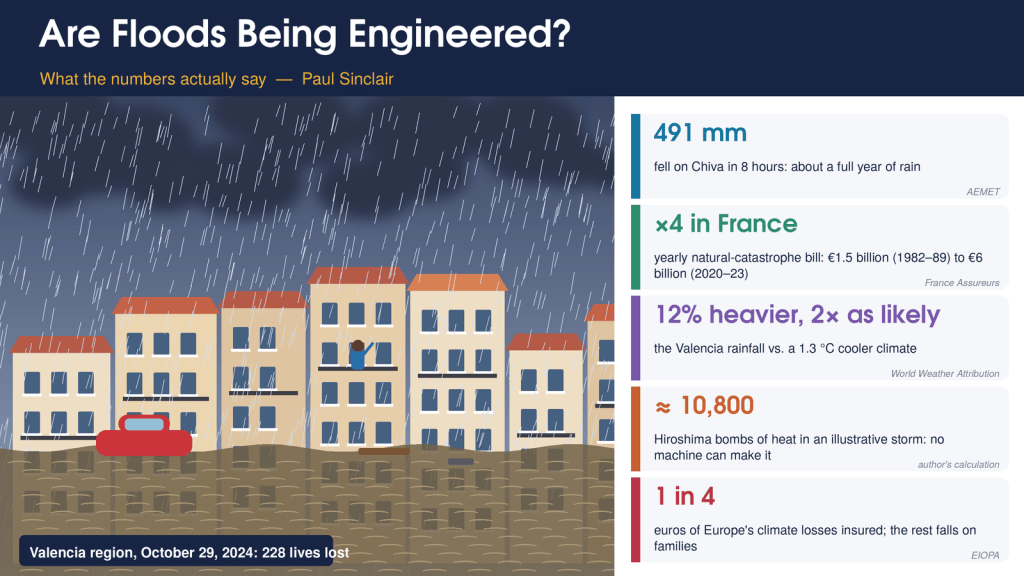
Scientists at World Weather Attribution estimated that the Valencia rainfall was about 12% heavier and twice as likely as in a pre-industrial climate 1.3 °C cooler. (WMO) That is not a theory invented after the fact; it is what the physics predicts.
The numbers from that day are staggering:
- In Chiva, 491 litres fell on each square metre in only eight hours, practically a full year of rain. (AEMET via OnCuba)
- In Turís, a station recorded 771 mm in a single day. (The Local)
- Mainland Spain had its wettest October since records began in 1961. (The Local)
A hydrology professor at the Polytechnic University of Valencia, Félix Francés, judged the flood a magnitude expected only once every 3,000 to 5,000 years. (report) Nature, not a laboratory, produced it.
France: the same story, year after year
France is living the same transformation. In January 2026, heavy rain flooded the Aude, Hérault and Corsica, and parts of Narbonne had to be evacuated. (GDACS) In Corsica, up to 250 to 380 mm fell locally around Ghisoni in a few days. (Corse Net Infos)
One month later, Storm Nils struck the west with what Météo-France called “uncommon strength”. Two people died, up to 900,000 customers lost power, and the Garonne flood kept Gironde and Lot-et-Garonne on red alert. (AP via Mongabay)
The bill tells the trend. According to France Assureurs, the average yearly cost of natural catastrophes rose from 1.5 billion euros in 1982–1989 to 6 billion euros in 2020–2023. (Futura) Over the roughly 36 years between those periods, that is a fourfold rise, about 3.9% more every year:
That is not the signature of a hoax. It is the steady compounding of a warmer climate and more homes in harm’s way.
What a mathematician sees in these numbers
Four calculations any secondary student could check show why no human hand made these floods.
1. A year of rain in an afternoon. One millimetre of rain on one square metre is one litre. So Chiva’s 491 mm put 491 litres, about half a tonne of water, on every square metre. On a single square kilometre that is 491,000 m³, the volume of about 196 Olympic pools of 2,500 m³ each.
2. The 7% rule meets 1.3 °C. Compounding 7% per degree over 1.3 °C gives about 9% more water vapour:
1.07^1.3 ≈ 1.09
The scientists measured about 12% heavier rain, the same order of size. Applied to Chiva, rain 12% heavier means about 491 ÷ 1.12 ≈ 438 mm without warming: some 53 mm extra, itself a heavy storm in most cities.
3. What cloud seeding could, at best, have done. If seeding adds 20% at most, then for 491 mm to fall, nature had to deliver 491 ÷ 1.2 ≈ 409 mm on its own. That is already a catastrophe. Seeding can nudge a storm; it cannot create one.
4. The energy of a storm. Take an illustrative 300 mm over 1,000 km². That is 300 million m³, or 3 × 10¹¹ kg of water. Condensing each kilogram releases about 2.26 million joules:
E = 3 × 10¹¹ kg × 2.26 × 10⁶ J/kg ≈ 6.8 × 10¹⁷ J
The Hiroshima bomb released about 6.3 × 10¹³ J, so this storm released the heat of roughly 10,800 such bombs. No machine on Earth commands that power.
The arithmetic is clear: these floods are far too large to be engineered. Yet one part of every disaster is engineered, by us.
The real “behind the scenes”: where we build, and when we warn
If anything is “engineered”, it is our exposure. Rain falls on hills; the damage happens where people have been allowed to live in the water’s path.
We build where water has always gone. Paiporta and Catarroja, the towns with the most deaths, have 16,775 homes in flood-risk areas. In the province of Valencia, 15 municipalities have every single property in a flood zone. (ARA)
The risk was mapped. A regional flood plan was approved in 2003, but it is not binding and does not apply to what was already built. (The Local) About 70% of urban plans in l’Horta Sud predate it and were never reviewed. (ARA)
The warning came after the water. AEMET raised the red alert for the whole province of Valencia at 9:41 in the morning. (Ebre Digital) The emergency text message reached phones at 8:11 in the evening, about ten and a half hours later. (ARA)
By then, Chiva, Requena and Utiel were already flooded. The technician who validated the alert told the judge it had been under discussion since 6:36 p.m., some 95 minutes earlier. (ARA) No conspiracy is needed to explain the tragedy. Ordinary failures of planning and decision are enough.
Who pays: the innocent without insurance
In Europe, only about a quarter of weather and climate losses have been insured. (EIOPA) Put simply, for every 100 euros of flood damage, about 75 fall on families, small businesses and taxpayers.
The poorest are the most exposed. The share of low-income consumers insured against natural catastrophes fell from about 14% in 2022 to 8%. (Hogan Lovells, on EIOPA and ECB data) A study by the European Commission’s Joint Research Centre puts the cost of uninsured flood risk to EU public finances at up to 27 billion euros a year. (Insurance ERM)
Some countries have already found a better way. Here is how three systems compare:
| Country | How flood damage is covered | What it shows |
|---|---|---|
| Spain | The public Consorcio pays extraordinary floods automatically for anyone with a property policy | After Valencia 2024: 250,663 claims, an estimated 4.8 billion euros, about 19,000 euros per claim (Consorcio) |
| France | The CatNat regime adds a compulsory surcharge to every home policy, backed by the state | The surcharge rose from 12% to 20% in January 2025; the Senate warns it will not be enough (Sénat) |
| Canada | Standard home policies exclude flood; a national program was promised in 2019 | About 1.5 million high-risk households, roughly 10%, cannot get affordable flood cover; no launch date as of mid-2026 (Insurance Business) |
The lesson is mathematical as much as moral: when a risk is pooled across a whole nation, each household pays a little. When it is not, a few families lose everything.
What governments must do for the innocent
Six measures would protect the people who pay the highest price today.
- Make catastrophe cover automatic. Follow Spain and France: a small compulsory surcharge on every property policy, pooled nationally, so no insured household is left out.
- Canada: deliver the promised national flood insurance program. The 2025 campaign pledged 450 million dollars and an April 2026 launch; that date has passed with no timeline. (Money.ca) Seven years of promises is long enough.
- Help the uninsured directly. A means-tested disaster fund should pay low-income families within weeks, not years, for the essentials: a dry home, a working car, a fridge.
- Stop building where water has always gone. Flood maps must become binding, with no new homes in the highest-risk zones and public aid to retrofit or relocate the old ones.
- Send warnings before the water, not after. A red alert from the weather service should trigger the phone alert automatically, with drills so people know what to do.
- Build a European safety net. In December 2025, EIOPA and the European Central Bank proposed an EU-level scheme to backstop natural catastrophe insurance. (Hogan Lovells) It deserves to move from paper to law.
Conclusion: nobody engineers the rain
The evidence points one way. The floods are not engineered: no technology can command the energy of thousands of atomic bombs, and those who would gain from a hoax are losing billions.
What has changed is measurable. Warmer air carries more water, so Mediterranean storms now fall harder and more often, exactly as the physics predicts.
The real scandal lies elsewhere: homes built on mapped flood plains, warnings sent after the water, and families left without insurance. Those are human choices, and human choices can be changed.
No one is engineering the rain. But for decades we have engineered our exposure to it. It is time to engineer our protection, starting with the innocent who have none.
Paul Sinclair is a retired mathematics teacher who taught for 23 years with the Vancouver School Board, and the author of the series The Perfect Math Tutor for All.
Sources
- Euronews: Cleanup begins in flood-hit eastern Spain (October 21, 2026)
- ARA: Alert validation and timing, final toll of 228
- ARA: Post-DANA urban planning, homes in flood zones
- Maldita.es: Disinformation about the DANA that crossed borders
- Maldita.es: The Morocco geoengineering conspiracy theory
- Euronews: How conspiracy theories about Spain’s floods spread online
- WMO: Devastating rainfall hits Spain (World Weather Attribution estimate)
- OnCuba News, citing AEMET: 491 l/m² in Chiva in eight hours
- The Local Spain: Wettest October on record
- The Local Spain: How the floods forced Spain to rethink how it builds
- Report quoting Prof. Félix Francés on the flood’s return period
- Ebre Digital: AEMET alert timeline, October 29, 2024
- GDACS: France, severe weather and floods (January 21, 2026)
- Corse Net Infos: Rainfall totals in Haute-Corse (January 20, 2026)
- AP via Mongabay: Storm Nils leaves two dead in France (February 2026)
- Futura, citing France Assureurs: Cost of natural catastrophes in France
- Consorcio de Compensación de Seguros: The 2024 Valencia floods
- EIOPA: Leveraging insurance to shore up Europe’s climate resilience
- Hogan Lovells: The natural catastrophe insurance gap and an EU backstop
- Insurance ERM: EU flood protection gap could cost €27bn a year
- Sénat: Régime CatNat report
- Insurance Business Canada: 1.5 million high-risk households
- Money.ca: Canada still has no national flood insurance


Leave a Reply