The decision stood

In the early 2010s, I sat in staff meetings where experienced mathematics teachers, myself among them, objected to removing financial mathematics from the curriculum. We knew what compound interest does to a credit card balance. We said so. The decision came from above, and it stood.
Years later, Canadian households owe about $1.76 for every dollar of disposable income. I cannot prove that one caused the other; debt has many fathers. But I know what happens when people who see a problem either stay quiet or speak and go unheard: bad policy goes unchallenged.
Both kinds of silence are widespread today. The numbers show what they cost us in immigration, schools and family life.
Measuring the silence
How many people hold their tongues? Enough to measure.
In a 2020 Cato Institute and YouGov survey of 2,000 Americans, 62% said the political climate prevented them from saying things they believed. The striking detail is who feels it: 77% of conservatives said so, but so did 64% of moderates and 52% of liberals. Self-censorship is not one camp’s grievance; it is a majority experience.
Canada is calmer, but not immune. In an April 2024 Leger poll of 1,610 Canadians, 57% said free speech in Canada is under threat. Most still felt comfortable sharing their views, yet on controversial subjects such as abortion, gun control and immigration, nearly three in ten did not. A minority, but a large one.
For a mathematician, this is not a matter of feelings but of information. Every person who stays quiet removes one honest data point from the conversation. Remove enough of them, and the public picture no longer matches what people actually think.
The mathematics of silence
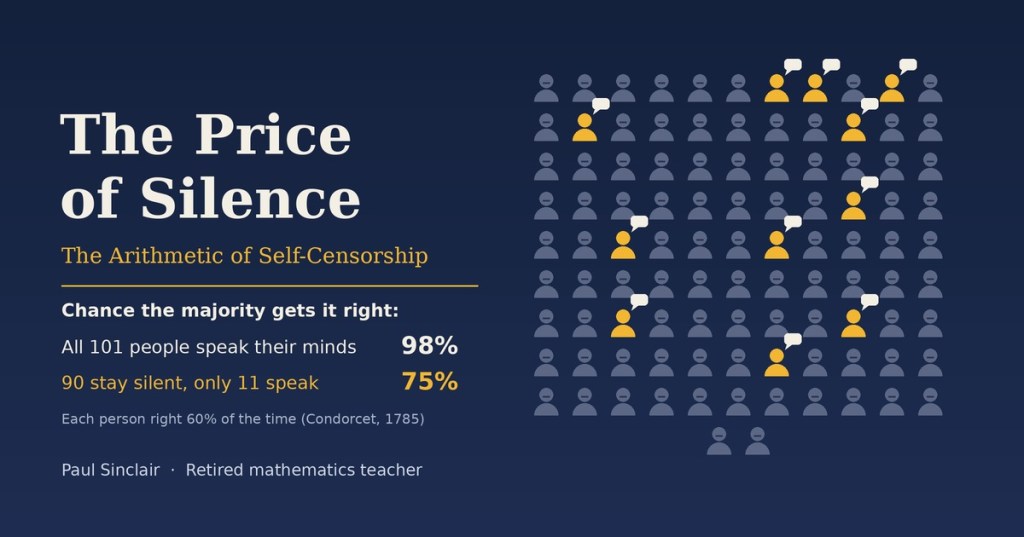
In 1785, the French mathematician the Marquis de Condorcet proved something remarkable. Suppose each member of a group has a slightly better than even chance of judging a question correctly, say 60%. If they vote independently and honestly, the majority’s chance of being right grows with the size of the group.
The arithmetic is striking. With 11 independent voters, the majority is right about 75% of the time. With 101, it is right about 98% of the time. Honest voices, added together, become wisdom.
But Condorcet’s result depends on one condition: each person must report their own judgement. Now suppose 90 of those 101 people stop saying what they think and simply repeat what seems acceptable. Their echoes add no new information. In effect, the group is left with only 11 honest voices, and its accuracy drops from 98% to 75%. Any statistician would reject a conclusion drawn from just 11 observations; yet that is exactly what a silenced society relies on. Nothing about the people has changed, only their willingness to speak.
The economist Timur Kuran gave this a name: preference falsification, the gap between what people believe privately and what they say publicly. In Private Truths, Public Lies (1995), he showed how that gap can grow quietly for years and then close suddenly, as when the regimes of Eastern Europe collapsed in 1989 and surprised nearly every expert. Silence does not make disagreement disappear. It only hides it until it erupts.
Case study: immigration
Canada’s population grew by 1,271,872 people in 2023, or 3.2%, the fastest pace since 1957. Most of that growth came from temporary residents: international students and temporary workers.
For years, raising concerns about the pace of immigration risked being mistaken for hostility toward immigrants. Many Canadians kept their worries about housing, doctors and classroom space to themselves.
Then the gap closed, just as Kuran would predict. In 2022, 27% of Canadians told Environics there was too much immigration; by 2023 the figure was 44%, the largest one-year change since the survey began in 1977. In October 2024, Ottawa cut its 2025 permanent-resident target from 500,000 to 395,000 and set out to reduce temporary residents, and the prime minister admitted, “we didn’t get the balance quite right.”
The lesson is not that immigration is bad. Well-managed immigration, selected on merit and matched to a country’s capacity, is one of the most productive policies any nation can adopt, and Canada’s points system has long been admired for exactly that; economic immigrants make up around 60% of permanent-resident admissions. Many of us, myself included, chose this country. The lesson is that a policy no one feels free to question cannot be adjusted gradually. It can only be corrected abruptly, and abrupt corrections are costly for everyone, newcomers most of all.
Case study: schools
In 2003, Canadian 15-year-olds scored 532 in mathematics on the OECD’s PISA assessment, among the best in the world. By 2022, the score had fallen to 497: a 35-point drop, and below the 500 mark for the first time.
Honesty requires a caveat: scores fell across most OECD countries, and the pandemic, smartphones and curriculum changes all played a part. No single cause explains it.
But a decline lasting nearly twenty years is not a sudden shock; it is a slow one, the kind that people inside the system see coming. Teachers notice when students can no longer do mental arithmetic, or when a course like financial mathematics disappears. Many of us said so. Too often, as in those staff meetings, the objection was heard and the decision stood.
Teachers are the closest observers of what works in a classroom. When they can speak the truth freely, without fear of repercussions for their careers, problems are caught early and fixed gradually. When they can’t, or when they speak and nothing changes, the system loses its best early-warning signal. Freedom to speak the truth is not a luxury in a democracy; it is how a democracy corrects its mistakes.
Case study: the family
In 2025, Canada’s fertility rate stood at 1.26 children per woman, tied with 2024 for the lowest ever recorded and well below the 2.1 needed to keep a population stable without immigration.
Few public issues carry larger long-term consequences, for pensions, health care and the labour force, yet few are discussed less openly. Raising it can feel like judging other people’s private choices, so most of us say nothing.
The data suggests the silence is costly. In 2022, Statistics Canada found that 38% of Canadians in their twenties did not believe they could afford a child within the next three years, and 32% doubted they could find suitable housing to start a family. A gap between what families want and what they can manage is a problem a country can work on, but only if it is willing to name it.
Respecting each family’s choices and talking honestly about the trends are not in conflict. A democracy can do both.
The fair counterargument
Critics of this argument make serious points, and they deserve a fair hearing. Much of what is called “political correctness,” they say, is simply courtesy: avoiding insults is not censorship. Canadian law already protects free expression under section 2(b) of the Charter, with narrow limits such as hate speech. And when others criticize what we say, that is not silencing us; it is their own free speech at work. Some add that, for generations, it was minorities and women whose voices went unheard.
All of this is true, and none of it changes the numbers. The problem is not the law; it is fear. When most people in every political camp say they hold back their views, the cause is not legal punishment but social and professional repercussions. Courtesy and candour are not opposites: we can speak the truth without insulting anyone. And as John Stuart Mill argued in On Liberty (1859), freedom of speech means little if it protects only the views we already share.
Conclusion: the price of silence
We were born free, and freedom begins with the right to say what we see. A democracy that silences its citizens, or simply stops listening to them, is not protecting anyone; it is flying blind. Condorcet’s arithmetic shows why: every voice withheld makes our shared decisions worse.
The remedy is simple. Say what you see, backed by facts. Listen to those who disagree, because they may hold the piece you are missing. And if you make decisions for others, explain them, and be willing to change course.
The price of silence is paid by all of us. The remedy costs nothing but courage.
Sources and data
- Marquis de Condorcet, Essai sur l’application de l’analyse à la probabilité des décisions rendues à la pluralité des voix (1785)
- Timur Kuran, Private Truths, Public Lies (Harvard University Press, 1995)
- John Stuart Mill, On Liberty (1859)
- Canadian Charter of Rights and Freedoms, section 2(b)
- Voter probabilities: author’s calculations (binomial distribution, 60% individual accuracy)
- Statistics Canada, National balance sheet and financial flow accounts, second quarter 2026 (released September 11, 2026)
- Cato Institute and YouGov, national survey on self-censorship (July 2020)
- Leger poll on freedom of speech in Canada (April 2024), via CTV News
- Statistics Canada, Canada’s population estimates, fourth quarter 2023 (released March 27, 2024)
- Environics Institute, Focus Canada survey on immigration (fall 2023)
- Immigration, Refugees and Citizenship Canada, 2025–2027 Immigration Levels Plan (October 24, 2024)
- Library of Parliament, HillNotes: Recent Evolution of Canadian Immigration Policy (2024)
- Council of Ministers of Education, Canada, PISA 2022: Canadian results
- Statistics Canada, The Daily: Fertility and baby names, 2025 (September 23, 2026)
- Statistics Canada, survey of young adults’ family plans, 2022, as reported by CBC News
If you’re a WordPress.com member, you can click ★ Like below.
For additional comments, see About the Author.


Leave a Reply