The word too far
On August 27, 2026, in Paris, before business leaders gathered at the Medef’s annual summit (the REF), Ursula von der Leyen declared: “Europe has savings. Unfortunately, these savings are lazy.” She was referring to the €10 trillion that European households keep in bank deposits, and promised to free up to €470 billion of it for businesses.
My reaction, posted as a comment on LinkedIn, was immediate:
While low-income European households sacrifice as best they can to save in the face of an uncertain future, national governments, under the umbrella of the European Union, the main cause of this economic disaster, go so far as to insult them! What shame and what arrogance to call savings “lazy”! Undeniably, this is excessive zeal on Ursula von der Leyen’s part. She must know that taxpayers, who still bear the consequences of the inflation caused by excessive spending, no longer trust investment vehicles that benefit only the centralized banking system.
I do not take back a single word. But a mathematics teacher does not stop at indignation: he calculates. So here is the arithmetic of savings that are not lazy. They are melting away.
First calculation: savings in retreat
From 2017 to 2023, the prudent saver lost an average of 0.94% of purchasing power per year on a Livret A, France’s tax-free regulated savings account. That is not laziness: it is erosion.
The real return on an investment is its nominal rate adjusted for inflation:
Real return ≈ account rate − inflation
When inflation exceeds the account’s rate, savings lose value, even as the displayed balance grows.
Real return on the Livret A, year by year:
2022: −3.83%
2023: −1.98%
2024: +1.00%
2025: +1.16%
2026: likely negative (average rate 1.60%)
Sources: MoneyVox, MoneyVox 2026.
Now in euros. A family that had €10,000 in a Livret A in 2017:
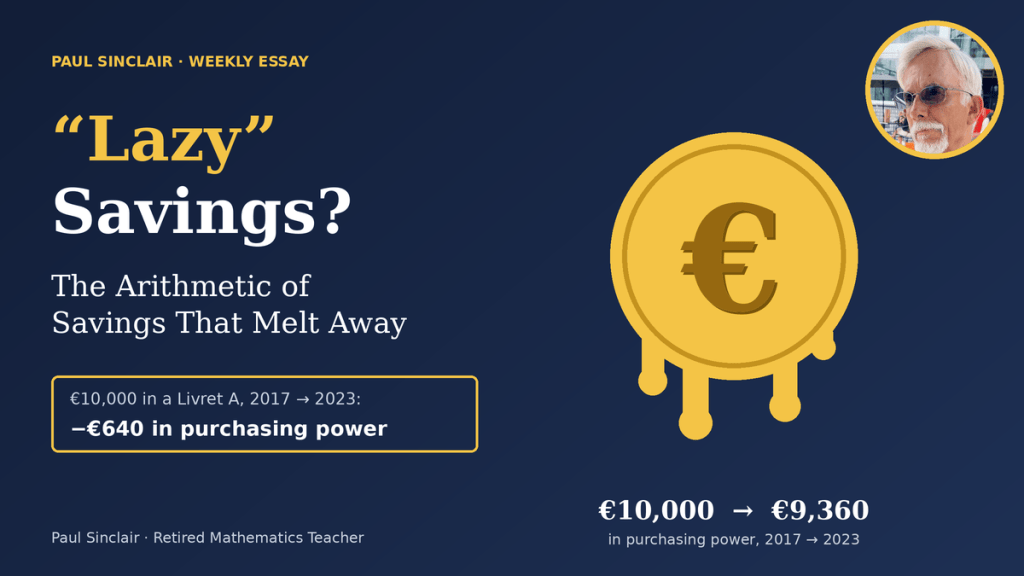
- after seven years at −0.94% per year: 10,000 × (0.9906)⁷ ≈ €9,360 in purchasing power, so €640 gone;
- over 2022 and 2023 alone: 10,000 × 0.9617 × 0.9802 ≈ €9,427, so €573 lost in two years.
INSEE, France’s national statistics institute, confirms it: in 2022, tax-free savings accounts and home savings plans (PEL) reached their lowest real rate since 1982. And this decline was no accident: since 2017, the government has removed the rule that prevented the Livret A rate from falling below inflation.
Second calculation: the printing press
In four years, the Eurosystem’s balance sheet nearly doubled: from €4,470 billion in early 2018 to about €8,800 billion at its peak in June 2022. This money was created to buy securities, a large share of them public debt.
The peak is easy to calculate: the European Central Bank has since reduced its balance sheet by €2,375 billion, or 27%. So 2,375 ÷ 0.27 ≈ €8,800 billion. Meanwhile, the ECB kept its deposit rate below zero for years: savings were penalized even before inflation returned.
What do economists say about this money’s role in the 2022 inflation? The OFCE (Sciences Po) notes that the expansionary monetary and fiscal policies of 2020 and 2021 supported demand, and that their calibration may have helped fuel inflation. The ECB, for its part, points to energy as the main driver: +40.7% year over year in September 2022, against the backdrop of the war in Ukraine.
The truth, then, fits in two sentences. The spark of 2022 came from energy. But years of abundant money and borrowed public spending had prepared the ground, and it was the saver who paid the bill, without ever being consulted.
Third point: a perfectly rational distrust
Brussels is not confiscating savings: it wants to move them, and the saver will carry the risk. On September 30, 2025, the European Commission issued a non-binding recommendation inviting member states to create savings and investment accounts with favourable tax treatment. Participation remains voluntary.
But look at what this shift changes. In a Livret A, €10,000 stays €10,000 in nominal value, guaranteed. In a market investment, a 20% drop wipes out €2,000 in a few weeks, and management fees take their share every year, whatever happens. The expected gain is real, but the risk changes sides: it moves from institutions to families.
And these families have a memory. They saw their savings melt in 2022 and 2023, the negative rates, the Livret A’s protective rule removed in 2017. That they refuse to entrust more to the same system is not laziness: it is prudence, grounded in numbers.
A saver who keeps money on deposit does not have a motivation problem. The institutions have a trust problem.
Born to be free
Arithmetic does not lie: European savings are not lazy, they have been made poorer. Between 2017 and 2023, a €10,000 savings account lost about €640 in purchasing power, while money creation doubled the central bank’s balance sheet.
Before asking families to take on more risk, European leaders should start with three simple steps:
- Guarantee that regulated savings never earn less than inflation, by restoring the floor removed in 2017.
- Keep their own accounts in order: public spending financed by money creation is a hidden tax on savers.
- Respect savers in words as well as in deeds. No one is persuaded by being insulted.
We are born to be free, including free to use our savings as we see fit. Saying so is not being politically incorrect. It is simply telling the truth, with the numbers to prove it.
Sources
- Von der Leyen’s remark, Medef REF, August 27, 2026 — France Épargne
- Real return on the Livret A, 2017–2024 — MoneyVox
- The Livret A in 2026 — MoneyVox
- Real return on savings accounts since 1982 — INSEE
- Eurosystem balance sheet in 2018 — OFCE
- ECB balance sheet reduction since June 2022 — OFCE
- Expansionary policies and inflation — OFCE
- ECB Economic Bulletin No. 7/2022 — Banque de France
- Recommendation on savings and investment accounts — Économie Matin


Leave a Reply