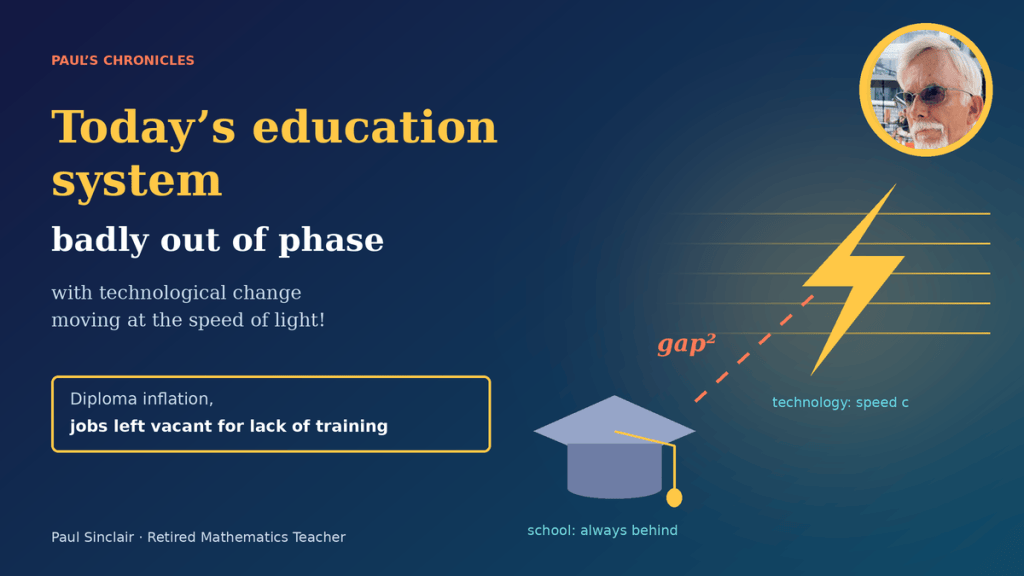
Today’s education system lags well behind technological change. This is not a question of goodwill: teachers and schools accomplish a great deal with the means they have. It is a question of speed.
On one side is an economy that transforms itself within a few years under the influence of artificial intelligence, automation and the energy transition. On the other is an institution built for stability, which renews its curricula at the slow pace of reform. Between the two, a gap is widening: an inflation of diplomas that no longer meet the specific needs of the job market, and positions that stay vacant for lack of specific training.
Two Clocks No Longer Ticking in Time
According to the World Economic Forum’s Future of Jobs Report 2025, employers expect about 39% of today’s skills to change by 2030. In other words, nearly four in ten skills taught today will be transformed, or even obsolete, before a student who started high school this year enters the job market.
The same report finds that 86% of employers expect artificial intelligence to transform their business. Yet half of them say they lack the necessary skills in-house.
The arithmetic is simple: when technology moves in years and training in decades, the gap does not shrink. It accumulates.
Here is that arithmetic. If 39% of skills change every five years, the share of a graduate’s skills still current after t years is:

This gives a half-life of about seven years: seven years after graduation, half of what was learned is already outdated. Over a 40-year career, only about 2% remains current unless it is renewed. And this assumes the pace stays steady; if it speeds up, the gap grows faster still.
Jobs Left Vacant for Lack of Training
This gap is not theoretical. In France, the 2026 Besoins en main-d’œuvre (Labour Needs) survey by France Travail, the national employment agency, counts nearly 2.3 million hiring projects. Of these, 43.8% are considered difficult by employers.
The main reason is telling: 84% of employers cite a mismatch in the profiles they receive, and 82% a shortage of candidates. The jobs exist, and so do the candidates, but their training does not match the needs.
Worldwide, the picture is the same: 63% of employers rank the skills gap as the main obstacle to transforming their business. Ahead of resistance to change, ahead of regulation: training.
The Human Cost of the Gap
Behind every vacant position there is often a graduate who cannot find a place. They did what was expected of them: study, pass their exams, earn their diploma. But the diploma, designed for a world that changes faster than it does, does not open the doors they hoped for.
Over the long term, the repercussions go beyond salary. Having a job means being an integral part of the system, contributing, feeling like a full citizen. A generation trained for occupations that are changing risks feeling left out of an economy that moves on without it.
At the macroeconomic level, the paradox is costly: employers who cannot find candidates, and candidates who cannot find jobs matching their training. A job market poorly adjusted in space and time cannot meet the urgent demand for skilled workers created by technological progress at the speed of light.
Catching Up: Four Paths
If the problem is one of speed, so is the solution. The task is to bring the two clocks back together.
- Read the job market in real time. The data exist: the Labour Needs survey details needs by occupation and region every year. It should guide student counselling and the opening of programs, locally and annually.
- Train with employers. Work-study programs and apprenticeships put students in touch with real tools. Training then follows the pace of business, not that of the next reform.
- Train the trainers. A teacher cannot pass on a technology they have not had time to learn. Time and resources devoted to their own updating are a direct investment in their students.
- Make the diploma a starting point. With 39% of skills set to change by 2030, no initial training is enough for a whole career. Lifelong learning must become the norm, accessible to everyone at every age. Businesses have understood this: 77% plan to reskill their staff to work alongside AI.
All four paths rest on one principle: knowledge is not used up like a barrel of oil. If I give you a dollar, I no longer have it; if I give you an idea, we both have it. The economist Paul Romer received the 2018 Nobel Prize for showing that ideas are “non-rival” and the engine of long-term growth. An economy built on knowledge has no ceiling, and every dollar spent on education is an investment in a resource that multiplies as it is shared.
Romer’s model puts this in a single line:

Here A is the stock of knowledge, 
Conclusion
The education system has not failed: it was designed for a different pace. Technology changes in years, schools in decades, and it is this gap, not a lack of effort, that leaves jobs vacant and graduates without a place.
The good news is mathematical: a difference in speed is corrected by changing the speed. Listening to the job market, training with employers, training the trainers and learning for life: each of these paths brings school closer to the world it prepares students for.
And you: in your field or your region, do you see this gap?


Leave a Reply