Two Kinds of Prudence
Last August in Paris, European Commission President Ursula von der Leyen described the roughly €10 trillion that European households keep in bank deposits as “lazy” savings. Her goal was to steer that money toward investment in Europe’s economy.
A few months earlier, in December 2025, EU leaders had agreed to borrow €90 billion on capital markets and lend it to Ukraine for 2026 and 2027.
So Europe now shows two kinds of prudence. Households save because the future is uncertain. Institutions borrow because the present is urgent. The question here is not which one is right. It is a question of arithmetic: who decides, and who pays?
Who Decides
The €90 billion loan went through several hands. The Commission drafted it, the 27 leaders agreed to it at the European Council, the European Parliament voted for it in January 2026, and member governments adopted it in February.
The agreement was unanimous, yet not everyone takes part. Hungary, Slovakia and the Czech Republic opted out of the joint borrowing, so the cost falls on the other 24 countries. In other words, national governments did have a say, and three of them used it to stay out.
Still, a voter in Lyon or Lisbon never voted on this loan. They elect a national government and members of the European Parliament, who then decide on their behalf, far from home. The issue is less an absence of decision than a distance from it.
Who Pays
Ukraine pays no interest on this loan. The EU budget does: about €1 billion in 2027, then about €3 billion a year from 2028. Agence Europe estimates the total interest at around €20 billion.
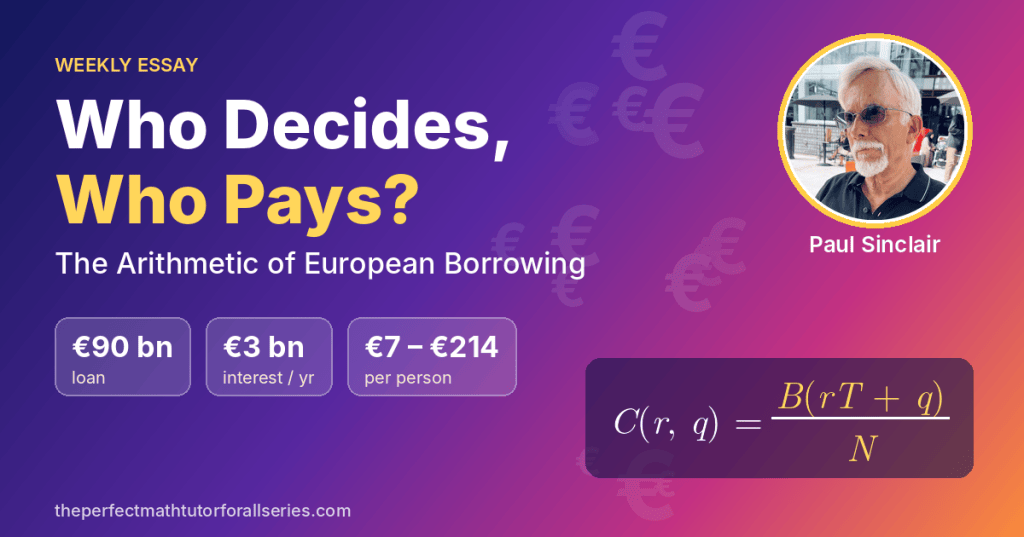
That budget is funded mainly by contributions from member governments, which come from their taxpayers. Spread over the roughly 420 million people in the 24 participating countries, €3 billion a year is about €7 per person per year. That is my own rough estimate, not an official figure.
The principal is a different matter. The loan has no maturity date, and Ukraine repays it only once Russia pays war reparations. If reparations never come and the bill falls back on the 24 countries, that would mean about €214 per person, on top of the interest. As I argued in “The Arithmetic of Public Debt,” a borrowed euro is eventually paid back by someone: through taxes, or through inflation.
Inflation is the quieter route. In the eurozone, governments cannot print money: the EU treaties forbid the European Central Bank from financing them directly. Yet the ECB bought large amounts of government bonds on the markets for years, and eurozone inflation peaked at about 10% in late 2022.
When prices rise, the real value of a debt shrinks. The borrower gains, while savers and people on fixed incomes, such as pensioners, lose the most.
The Arithmetic in Two Equations
The cost per person depends on several parameters at once, so it can be written as a function of them:

Here B is the €90 billion borrowed, r the average yearly interest rate (about 3.3%, implied by the official €3 billion a year), T the years of interest counted (7, from 2028 to 2034), q the share of the principal Ukraine never repays (from 0 to 1), and N the roughly 420 million people concerned.
If Ukraine repays everything (q = 0), the cost is about €50 per person over seven years. If it repays nothing (q = 1), it rises to about €264.
Partial derivatives show how sensitive the cost is to each parameter, in euros per person:


In plain words: each extra percentage point of interest adds about €15 per person, and each 10% of principal left unpaid adds about €21.
The second equation measures what inflation takes from savings S over t years at a yearly rate π:

Even at the ECB’s 2% target, €10,000 left in a deposit for 10 years loses about €1,800 of purchasing power. This is a general mechanism, not a cost of this loan alone, but it shows why savers watch public borrowing closely.
The Case on the Other Side
Supporters see the loan as an investment in Europe’s own security. About €60 billion of it is earmarked for Ukraine’s military needs, the rest for budget support. Spain’s Prime Minister Pedro Sánchez defended it on moral grounds and on respect for international law.
The European Central Bank adds a numerical argument. The €90 billion equals about 0.5% of EU GDP, and the yearly interest about 0.016%. In its view, that cost is modest compared with the EU’s overall budget and does not significantly raise the burden on member states.
Both arguments deserve to be weighed. A small cost can be a good bargain, if what it buys is worth it.
Conclusion: The Question That Remains
A household with €10,000 in the bank knows exactly what it holds. A citizen of the 24 countries has a much harder time knowing what share of a €90 billion loan they carry, or for how long.
And the deposits called “lazy” are exactly the money that inflation erodes first. About €7 a year is a modest sum; €214 per person is less so.
Consent given through elected representatives is still consent, in law. But is it enough, when the bill outlives the decision? We elect governments to serve us: should those who pay have a clearer say in what is borrowed in their name?
Sources
- Anadolu Agency: EU leaders agree on €90 billion loan (Dec 19, 2025)
- Sigmalive: opt-outs by Hungary, Slovakia and Czechia
- Il Sole 24 Ore: costs borne by 24 countries, no maturity date
- Censor.net: Commission proposal and Parliament vote, January 2026
- Brussels Times: loan adopted February 2026; 2027 tranche proposed
- Agence Europe: interest of about €20 billion in total
- The News (AFP): €60 billion for military needs, €3 billion yearly interest
- European Central Bank: letter on the loan’s cost relative to EU GDP


Leave a Reply