Why no one can list every zero, and why a proof doesn’t need to
By Paul Sinclair
Introduction
For more than 160 years, mathematicians have tried to prove that every non-trivial zero of Riemann’s zeta function lies on a single line. This essay invites mathematicians around the world to focus on one approach: a three-dimensional view of the zeta function’s polar form. On the critical line, the polar form turns the zeros into the roots of a real function. Seen in three dimensions, with |ζ| rising as a landscape above the plane, those zeros become the points where the surface touches the ground. My thesis is that studying this landscape with the tools of three-variable calculus could open the door to a new general equation, one that has not yet been created and that could explain why every zero must lie on the line.
1. A Leap After Decades
On August 10, 2026, Anthropic announced that a research version of its AI model, Claude, had moved a number that mathematicians had been pushing up slowly for decades. The number is the proven share of the Riemann zeta function’s zeros that lie on the “critical line,” where Riemann predicted all of them would be. Decades of patient work had brought it to five-twelfths, about 41.7%. The new proof lifted it to more than two-thirds, just over 67%. Mathematicians checked the argument, a proof-checking program verified every step, and other researchers have since found new proofs and raised the figure slightly.
Yet two-thirds is not all. If no one can test infinitely many points, how could anyone ever prove that every zero sits on that line?
2. The Question in Plain Words
The prime numbers, 2, 3, 5, 7, 11, 13 and so on, seem to appear at random. No simple rule predicts the next one. Yet in 1859, in a paper of only eight pages, Bernhard Riemann showed that their pattern is governed by a single function, the zeta function, ζ(s).
It begins as an easy sum: ζ(s) = 1 + 1/2ˢ + 1/3ˢ + 1/4ˢ + … Euler had already shown that the same sum can be written as a product over the primes alone. Riemann’s step was to extend ζ to complex numbers, s = σ + it, and to look at where the function equals zero.
Some zeros are easy to find: −2, −4, −6, and so on. These are called the trivial zeros. All the others, the non-trivial zeros, lie in a narrow vertical strip where σ is between 0 and 1. Riemann suspected that they all lie exactly on its centre line, σ = ½. That suspicion is the Riemann hypothesis.
Why does it matter? Each zero adds a small wave to the count of primes. If every zero is on the line, the count never strays far from its expected value. A single zero off the line would mean the primes are less orderly than we believe. The Clay Mathematics Institute offers a US$1 million prize for a proof.
3. Why Testing Every Point Can Never Work
Testing points one by one fails even before infinity comes into it. Pick any short stretch of the critical line, say between heights 14 and 15. It holds infinitely many points. No computer, however fast, could ever check them all. Testing alone cannot settle the question even inside a chosen interval.
What computers do instead is clever. In 2021, Dave Platt and Tim Trudgian confirmed that up to height 3 × 10¹² there are exactly 12,363,153,437,138 zeros, and that every one of them lies on the line. They did not test every point. They counted the zeros in each region, then located each zero on the line, and the two counts matched.
Impressive as it is, this is still not a proof. Twelve trillion is a finite number, and infinity minus twelve trillion is still infinity. A single zero off the line, at a height no computer will ever reach, would be enough to make the hypothesis false.
Mathematics has faced this kind of problem before. Around 300 BC, Euclid proved that there are infinitely many primes without checking a single large number. He reasoned about all of them at once. A proof of the Riemann hypothesis must do the same with the zeros.
4. Counting Without Searching
How can anyone count zeros without testing points? The answer comes from an idea every calculus student meets: Green’s theorem. What happens inside a region is fully determined by what happens on its boundary.
In complex analysis, this idea becomes the argument principle. Walk once around the edge of a rectangle in the critical strip and watch how ζ(s) turns as you go. The number of full turns it makes equals the number of zeros inside. Nothing inside the rectangle needs to be tested. Applied to the strip up to height T, it gives the Riemann–von Mangoldt formula:
N(T) = (T/2π)·log(T/2πe) + 7/8 + S(T) + a small error
The first part grows smoothly and is easy to compute. The term S(T) is the irregular part, and we will come back to it.
The second step uses the polar form. On the critical line, ζ can be written as
ζ(½ + it) = Z(t)·e^(−iθ(t))
where θ(t) is a known angle and Z(t) is a real function. Its size matches the size of ζ, and its sign changes every time ζ crosses zero. Finding zeros on the line becomes as simple as watching a real graph cross the axis. When the number of crossings equals N(T), no zero below height T can be hiding off the line.
Like any complex number in polar form, ζ has two parts. Its modulus, |ζ| = |Z(t)|, gives its size, and it falls to zero exactly at each zero. Its argument gives its direction: it equals −θ(t) when Z(t) is positive, and it jumps by π each time Z(t) changes sign. This is why the counting formula can also be written as
N(T) = θ(T)/π + 1 + S(T)
In short, the modulus finds the zeros, and the argument counts them. The angle θ(t) is the smooth, predictable part of the argument. S(T) is what is left over, the irregular part.
So where is the obstacle? It is S(T), which measures how much ζ twists along the line. Mathematicians know that it grows very slowly, but they cannot yet control it tightly enough to rule out a stray zero far up the strip. Every road to a proof seems to lead to this wall.
5. Three Ways the Problem Is Attacked Today
Raising the proportion. Since G. H. Hardy proved in 1914 that infinitely many zeros lie on the line, mathematicians have raised the proven share step by step, reaching five-twelfths, about 41.7%, by 2020. The 2026 jump to two-thirds took a different route. It started from Hugh Montgomery’s 1973 work on the spacing of the zeros, which had assumed the hypothesis, and removed that assumption.
The de Bruijn–Newman constant. The hypothesis is equivalent to a single number, Λ, being exactly 0. It is now known that 0 ≤ Λ ≤ 0.22. If the hypothesis is true, it is only barely true.
The Hilbert–Pólya idea. The zeros may be the energy levels of some physical system. Their spacing matches that of energy levels in heavy atomic nuclei, but the system itself has never been found.
Three different roads, and none has yet reached the end.
6. Conclusion: Is the Right Concept Born Yet?
My thesis is that the answer lies in geometry rather than in a formula listing the zeros.
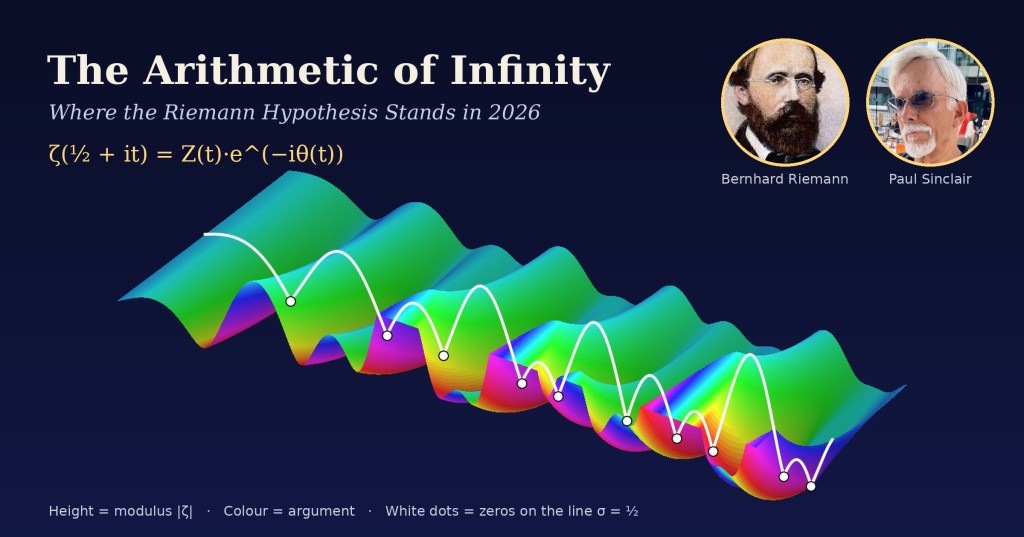
Picture |ζ(σ + it)| as a landscape rising above the plane. Mountains rise where the function is large and valleys sink where it is small. Each zero is a point where the surface touches the ground. The polar form describes this landscape along the critical line, and the formula above counts its touch-down points. The Riemann hypothesis then says something simple: every touch-down lies on one straight line, σ = ½. The open question is why the surface never touches the ground anywhere else.
Multivariable calculus offers the language for this question. The logarithm of |ζ| behaves like an electric potential, with each zero acting as a point charge. Gradients, flux and Green’s theorem all apply. Modern graphing software now lets anyone walk through this landscape in three dimensions, rotate it, and watch the valleys line up.
The argument adds a fourth dimension, in colour. Software such as Mathematica can draw the landscape with height showing the modulus and colour showing the argument. At each zero, the surface drops to the floor and every colour meets at a single point. On the critical line, those meeting points are exactly the roots of Z(t). Off the line, none has ever been found.
Still, seeing is not proving. My intuition is that the concept which turns this picture into a proof may not yet exist. History has seen this before. Zeno posed his paradoxes of motion around 450 BC, and they waited more than two thousand years for calculus to give them a clear answer. Perhaps the Riemann hypothesis is waiting for its own calculus.
I do not claim a proof. I offer a question, and an invitation to anyone who loves mathematics to think about it with me.
Three questions seem most worth asking:
- Can the polar form, or the landscape view, be extended off the critical line in a way that reveals why no zero can hide there?
- What would a bound on S(T), strong enough to prove the hypothesis, actually look like?
- Could the method behind the two-thirds result be pushed toward 100%, or does it have a natural ceiling?
If you have an idea, a correction or a reference, please share it in the comments. Riemann’s eight pages have waited more than 160 years. Perhaps the next step will come from a conversation.
Sources
- Anthropic, “Learning more about Claude’s mathematical capabilities,” August 10, 2026.
- L. Alpöge and R. Furman, “More than two thirds of the zeta zeros are simple and on the critical line,” arXiv:2608.13637, 2026.
- Y. Lamzouri, “A new proof that more than 2/3 of the zeros of the Riemann zeta function are simple and on the critical line,” arXiv:2609.02882, 2026.
- D. Platt and T. Trudgian, “The Riemann hypothesis is true up to 3·10¹²,” Bulletin of the London Mathematical Society, 2021.
- K. Pratt, N. Robles, A. Zaharescu and D. Zeindler, “More than five-twelfths of the zeros of ζ are on the critical line,” Research in the Mathematical Sciences, 2020.
- B. Rodgers and T. Tao, “The de Bruijn–Newman constant is non-negative,” Forum of Mathematics, Pi, 2020.
- D.H.J. Polymath, “Effective approximation of heat flow evolution of the Riemann ξ function, and a new upper bound for the de Bruijn–Newman constant,” 2019.
- Clay Mathematics Institute, The Millennium Prize Problems: the Riemann Hypothesis.


Leave a Reply